I picked up on the first ring.
“You here?” He said.
“Yeah, I’m in the Paradise Inn coffee shop.”
“Okay, I see you.” Chaingun came walking over as I took down the last of my quad shot Americano.
And I was immediately concerned.
Just twenty minutes prior, I had seen someone, or maybe had a vision of someone, galloping down the Muir snowfield. A seemingly endless expanse of warmed-over slush that stretches from the Skyline Trail to Camp Muir. It’s a 5,000-foot ascent across a blinding white tract, littered with zinc-nosed climbers, novices, and guides. The groups walk in rhythm, rehearsing the compression breathing and rest step, while projecting more fitness than they’ve earned. All with a backdrop of echoing ice falls and glacier cooled winds reminding you that the hard part is still ahead.
Pretty intense, huh?
This is the primary route for an ascent of Mount Rainier.
Mark, my tropical island-hopping friend, my high school tassel turning friend, my introduction to Led Zeppelin and Marlboro Reds friend, was now going to be my fall in a crevasse with minimal preparation friend.
He dreamed up this adventure just a few short months prior and now here we were. Judgment day.
My “team” was already at Camp Muir. I was arriving a day late, escorted by the galloping mountaineer standing in front of me.
After a quick check in at the Ranger Station, Chaingun was ready to ascend again.
But none of that is what concerned me.
I asked him, “How did you know it was me?”
He gestured towards my pack. “All the stuff.”
And that, is what concerned me.
I was a noob. I knew it, he knew it, and everyone in the Ranger Station probably knew it too.
I was in shape and ready to learn. But I was nervous as hell.
He escorted me to the back of my 4Runner and proceeded to unload the pack I’d spend an exorbitant amount of time and treasure filling. To the brim. He was shaking out the unnecessary and impulsive. All the nice to haves I’d picked up at REI would be left behind, but not before being properly mocked.

“How thirsty are you?” he asked, clanking my brand new 48-ounce wide mouth Nalgene up against the twice used 32-ouncer. “You can only absorb a half liter every hour. Chug now, take one liter with you, we’ll stop and make more as needed.”
He tossed the big bottle aside, along with the other items I’d been sold.
“Snacks?” Chaingun asked. “What did you bring for snacks?”
“Leftover pizza and gummy bears,” I said like a proud student, “as directed.”
“Good. And what’s this?” he asked, holding up a grease-soaked bag.
“Those?” I hesitated “Those are Snickers bars and Quarter Pounders.”
Chaingun didn’t say a word.
“Mike,” I said. “They’re for Mike. He texted me from Camp.”
Chaingun paused for a moment, considered the team that was waiting a few hours and a few thousand feet above us, and then stuffed the greasy bag into his pack.
“I’ll take them up, you need to conserve your energy.”
And with that, we set off through the wildflowers, onto the snowfield, toward Camp Muir, and eventually the summit.
Rainier taught me something about learning new skills, about pushing myself, about facing fears, both perceived and absolute. But it wasn’t until I connected that experience with an ancient Japanese concept that the trip really made its impact.
The Roots of Misogi
An old idea with a new twist has taken root in my brain.
Misogi. The Japanese Shinto practice of ritual purification.
You’ve probably seen it in action. Buddhist Monks standing under waterfalls in quiet meditation as a torrent of freezing water crashes all around them.
Why do they do it?
To cleanse the soul of course.
As the 43rd monarch of Japan, Empress Genmei commissioned a document that would preserve Japanese history. Specifically, she wanted to identify the direct lines of lineage between the emperors and the Japanese Shinto Gods. The artifact would include myths and legends describing the creation of Japan, heaven, earth, and the Gods.
In 712 AD, historian Ono Yasumaro delivered Kojiki, the “record of ancient things,” what is now the oldest living document in Japan.
In Kojiki we learned the epic tale of Izanagi, one of these Shinto Gods. Izanagi was married to the Goddess of creation and death, Izanami. Together, this power couple created the islands of the Japanese Archipelago.

As the legend goes, Izanami died during childbirth and descended to the land of the dead.
Izanagi was understandably distraught. After a lengthy grieving period, he decided to do something about it. He was a God after all, so he decided to descend into the underworld and get his wife back.
As Izanagi descended, he encountered demons, zombies, and all sorts of nasty inhabitants. This underworld was no open house, these characters wanted Izanagi to stay. Forever.
Eventually he identified his wife’s body, but it was unrecognizable. She had been taken over by darkness. She was partially decomposed and was becoming a demon, just like the others.
Izanagi would need to escape before he met the same fate.
He quickly moved through the caverns and caves, narrowly escaping the clutches of monsters and evil spirits. It took everything he had, but he eventually made his way back to the entrance, crashing across the threshold to freedom.
But he was not out of the woods yet.
Izanagi dove headlong into a nearby river to cleanse himself. The freezing waters were purifying. The waters propelled him into a state of sumikiri, which means “to be serene,” a pure clarity of mind and body. The waters washed away his impurities, weaknesses, and past limitations. Mind, body, and spirit were strengthened.
This ritual cleansing is now known as misogi. It is the path to sumikiri.
Awesome, right?
And this is why you see the Monks do what they do. It’s why people make pilgrimages to sacred waterfalls, lakes, rivers and perform misogi every year.
Of course, it wasn’t just the freezing waters, it was the trials that preceded them that left Izanagi in this blissful state of sumikiri.
A cold-water bath can do wonders for the mind and body; cold plunging has never been so popular.
But what is ritual cleansing without the dirt, the challenging experiences that precede it?
And that brings us to the modern, western interpretation of misogi. Not just an ice bath, but a challenge.
Modern Misogi
Entrepreneur, rapper, and public speaker Jesse Itzler has helped popularize misogi with 100-mile runs, bike rides across America, and his 29029 everesting challenge.
29,029 feet is the elevation of Mount Everest, so Itzler takes over Bald Mountain in Sun Valley, Idaho once a year to lead groups up and down Baldy fifteen times, for a total accumulated ascent of 29,029.
Not a bad way to go, especially if you hate lines.

29029 is a challenge. A big fucking challenge. The type of challenge that—like escaping the depths of the underworld—will push you to your physical and emotional limits.
Misogi.
Itzler learned about misogi from Kyle Korver. The former NBA three-point specialist played five seasons for the Atlanta Hawks, a team that Itzler and his wife Sara (Spanx) Blakely own.
Korver was a solid player whose talents were consistently underestimated. With the 51st pick in the 2003 NBA draft, the back-to-back Missouri Valley Conference player of the year was selected by the New Jersey Nets. They immediately sold his draft rights to the Sixers for $125,000. That covered summer league expenses, and the leftover cash was used to buy a new copy machine.
If you want to see a player with a chip on their shoulder, the time-tested methodology is trading them for a copy machine.
But from humble beginnings bloomed a respectable NBA career, and one of his secrets was an annual misogi.
When I heard an Itzler interview mention Korver, it spurred a memory. I had read an article about Korver in Outside Magazine a few years prior. This misogi thing sounded familiar.
It turns out, the article was from December of 2014. Time flies!
But I vividly recalled the details of Korver’s offseason workout program because it was absolutely wild.
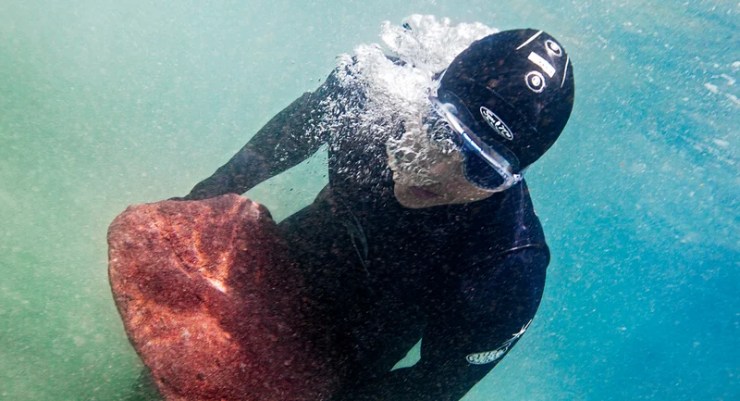
Run a 5K underwater carrying a boulder? Game on!

Stand-up paddle from the Channel Islands to Santa Barbara? Sure, that sounds like a good way to spend nine painful hours.
A true misogi, as I learned, is about testing your abilities in a foreign environment. It should be a real test. Something that drives your daily actions.
The thing that really stuck with me after my second reading of that article was the title.
“The One-Day-a-Year Fitness Plan.”
Brilliant. Of course, it should be more than just physical fitness, but brilliant all the same.
Pick something you are not familiar with, a skill to learn, a hobby to master. Find a challenge that you cannot do on autopilot. A task that takes your full concentration.
And work your ass off to make it happen.
That is the type of challenge that has an impact on you for the entire year. Training for it takes consistent, daily, mindful effort. No cramming for this test.
Completing it creates an everlasting “fuck yeah” glow that propels you forward into the next challenge.
And once complete, all your other obstacles seem much smaller.
It’s just one day a year, and the plan is to get ready.
End of plan.
These types of challenges push us, month after month, from our comfort zone. You can’t say that for the executive ropes course. Trust falls be damned.
And it’s a bit more than your standard Tony Robbins fire walk too.

Setting the Bar: The 50/50 Rule
Dr. Marcus Elliott of Peak Performance Project (P3) has been teaching this western version of misogi for several years.
Elliott worked with Korver during his playing days. Although P3 has all manner of technology for player development, the topic he is eager to discuss with outsiders is misogi.
He has just two rules for misogi.
One: It must be really fucking hard.
Two: Don’t die.
Challenging yourself to do things you don’t think are possible. Something where, even after a year of training, you’ve got a 50/50 chance of completing it.
If you can do that, you have likely found misogi. Working on something so hard, once a year, that it impacts the remainder of the year. And probably longer. That is a challenge worth taking on.
That is the ritual purification people need.
The Adventure Continues
Burien Outdoor Adventure Club, BOAC, didn’t start out with misogi in mind. It was established in 2012 after our failed attempt to summit Mount Rainier. Yeah. That ascent of Mount Rainier.
It took on a life of its own. It became a ritual, a challenge, and on the good years, a misogi.
Chaingun escorted me to Camp Muir that day, Snickers and Quarter Pounders in tow. He then took on the challenge of getting BOAC (a group he became a member of) to the summit.
Did we know about mountaineering? Did we have any experience roping up, using ice axes, rest steps, compression breathing, or operating with crampons?
Abso-fucking-lutely-not.
And of course we failed.
But we tried. We reached Disappointment Cleaver, not just a clever name, and made the decision to turn back. It was getting late, and the winds were kicking up.
Sitting there in the snow and watching the sun rise over Little Tahoma Peak, Yakima in the distance, we enjoyed our cold pizza and mostly frozen gummy bears.

The excursion wasn’t over, we still needed to make it down safely from over 12,000 feet, but we had a feeling of accomplishment, even without making the summit. We were disappointed, relieved, and exhausted.
Sounds like misogi to me.
And the tradition lives on. BOAC.
Two years prior to the Rainier excursion, we’d lost a friend in a tragic ski accident. Our friend didn’t lose his edge and fall while carving corduroy groomers at Sun Valley, en route to après-ski. The accident happened while doing something much more intentional. In line with what he loved to do. Ski Mountaineering on Pisco Mountain in Peru, taking first turns on a scouting run down the South Face, and being a next level bad ass. To keep the crew together and honor that spirit, we started doing a trip every year: an outdoor adventure. Not the south face of Pisco, but our version of it.
Hiking, biking, boating, floating, anything goes.
Some years—like this year—the hardest part is finishing all the beer. But most of them are challenging and somewhat painful. I don’t do public math, but I’d say they have a 50/50 chance of success.
In 2023 we completed the Maroon Bells Four Pass Loop. On that loop, you can tag a ‘14’er,’ a peak that is 14,000 feet. A height that has been taunting us (but mostly Mark) on every mission going back to the initial attempt on Mount Rainier.
And did we get the 14’er this time around?
Abso-fucking-lutely-not.
We got within striking distance, it pissed rain, and we were gassed. We could see the peak in the distance, and it looked, well, tall. Reports of rock falls and injuries in the area had us thinking twice, and we decided the four passes would be enough.
And they were.
We even managed to lose Mark on the trail, adding to the adventure.
While some of the trips are less physical, they all have a bit of misogi. Driving side by sides at top speed along the forest service roads of the Bradshaw Mountains might not be a test of physical endurance, but I’ll tell you what, I was pretty god damn nervous to rally those little monsters over boulders and across canyons.

I was even more nervous after that drive, entering a redneck bar in Crown King, AZ. We didn’t look the part, and I could swear I heard a record scratch as we walked in. Every head turned in our direction. Even the taxidermy casting judgement.
Outside of your comfort zone with minimal preparation? Yeah, that qualified. It was social misogi. And of course, we scurried out the door.
Remember, it’s a 50/50 chance of success, you will have failures.
An earlier trip had us night hiking into Desolation Wilderness. Miles from anywhere, headlamps on the trail, and the temperature dropping, we spotted a fire in the distance. We’d stumbled upon (rescued?) a stranded hiker (serial killer?), presenting a new kind of challenge. We fed him, scolded him, showed him the trail map, and then swaddled him in a tarp before bed. The next morning, he was gone. Up and vanished like a fart in the wind.
We called him Josh of the Woods, and we still do, every time we hear movement in the night.
![[Desolation Wilderness Camp #2]](https://i0.wp.com/winwithflynn.com/wp-content/uploads/2025/01/FCA85763-5721-4853-BBC6-356D6DD10FEB_1_105_c.jpeg?resize=1024%2C405&ssl=1)
Once we’d had our fill of Desolation Wilderness, saved a man, swam in mountain lakes, and finished the last of our Fireball, we decided more threats to our wellbeing were required.
You know, for the cleansing of our soul.
We joined a group of professional snowboarders and skiers, people with actual balance and skills and bravery, for a day of mountain bikes and bloodied shins on Lake Tahoe’s Rim Trail. It was a memorial ride for our friend and a sneak peek into his world.
Yeah, that’ll do.
Most years, we accomplish the mission. Which is to say that we go on the mission. The misogi lives on.
And I feel cleansed.
I’m sorry, you can’t join BOAC
But you can climb Rainier, you can walk into the back country, and you can ride mountain bikes, drive side-by-sides, save stranded hikers, and belly up to the bar at redneck saloons. In other words, you can misogi.
Have you taken on a misogi? Got one planned? Let’s hear about it. Call your shot, chime in, and share your plans in the comments.
If you enjoyed this post, please share it with a friend.







What do you think?