I’m on a plane to Kona right now.
As I look around, everyone on the plane is sharing something. A safe flight is a good start. Bonus points if it’s on time. But we are all a part of this shared experience. Headed to the big island.
And while we share the flight, I look a little closer and see all the different activities. Just in my family of four, the kids are watching different shows on different iPads and my wife is sleeping. I’m here observing everyone and writing this blog post. Sure, it’s a little creepy, but that’s where we’re at.
The question I’m asking myself is, are we sharing this time together? Is this a shared experience?
Later in the flight, we’ll share some M&M’s, some smiles, a can of wine if we’re lucky, and some shared looks of excitement. That will feel like a connection, right?
But a shared experience is about more than proximity. It takes participation.
Time multiplied by attention. That is what creates a bond. And somewhere along these X & Y axes lie you and your friends and your kids and your spouse.
Your coworkers and classmates too.
To complicate things, it takes two to tango. If it’s one-sided, like a stage-five clinger, the math stalls out. It’s multiplying by one.
Jeff Spicoli told Mr. Hand “If I’m here, and you’re here, doesn’t that make it our time?” Jeff failed that class, but he understood that relationships are two-sided. Mr. Hand could learn from that.
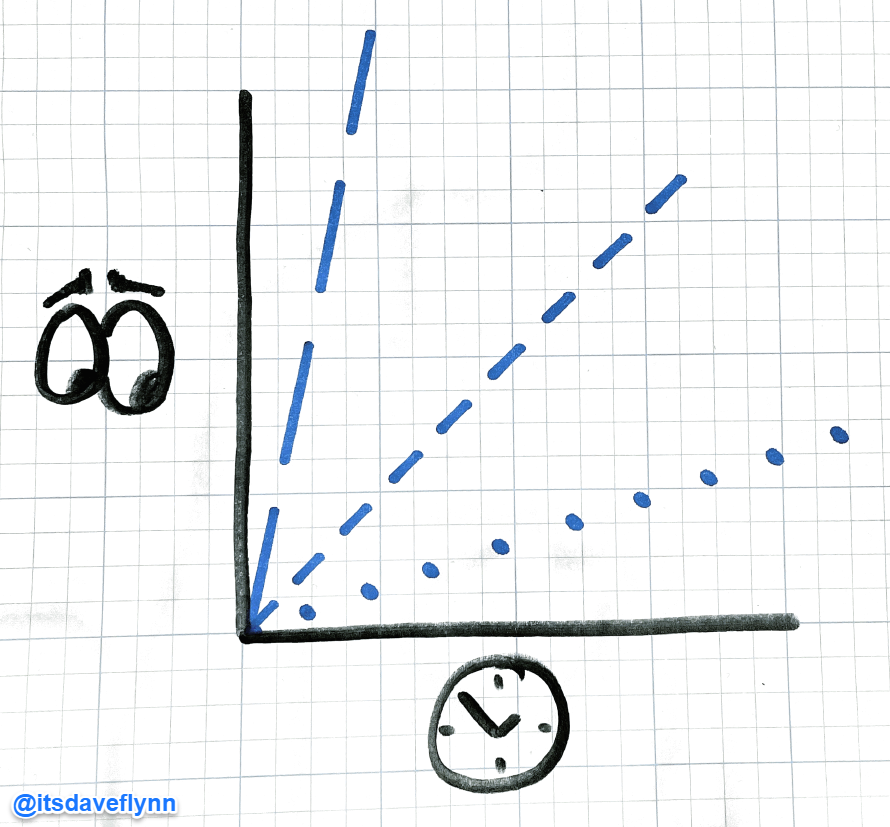
If we plot our time and attention on a chart, we can see what way we are trending. Up and to the right is good.
Here is the playing field.

And below, we have some standard trend lines which I’m calling Friend Lines (R) because I’m super clever.

Long dashes are those short bursts of intense attention. The Tony Robbins weeklong retreat culminating with a barefoot walk over hot coal. Memorable experiences that you’ll never forget, but do they build lasting friendships?
You had tears in your eyes when you left Camp Waskowitz in sixth grade. They played Good Riddance and everyone was hugging and saying see you soon, and I love you, and then you went off to Middle School. You spent more time with your dermatologist than with your fellow campers.
Short dashes are your standard relationships. Solid. Growing over time with proper care and feeding. You meet, you have something in common, you share time and experiences with each other, and your bond grows in kind.
This is healthy and sustainable. Do more of this.
Dotted line is the low and slow relationships. Like a pork butt, it will get there eventually.
A classmate you don’t know that well, maybe you end up at the same college, so you keep in touch. Kids end up in Little League together, so you chat or have a beer. You’ve “known them your whole life.” The conversations are easy and over time that can create a solid relationship, but it lacks the carefully placed attention that your deep relationships have.
Here’s the graph again to save you a scroll. What line do your relationships track?

Of course, no relationship falls directly on any one of these paths. That would be no fun at all. Too predictable.
What we get are all different trajectories because people are people, not logarithms.
But we do see certain patterns, don’t we?
Here’s one. Boy meets girl. They are friends. Then suddenly they think, hey we should date and get married and buy a house and have kids. And yeah, that can happen really fast. Time isn’t speeding up, you are just being much more attentive and intense, so the bond grows as you can see, up and to the right, with increasing velocity.

On the flip side, you can have some killer experiences but not a lot of time together.
Experiences without much time are memorable, but they can be jarring.
The chart gets a little lumpy and the bonds don’t grow in proportion to the size of the events because of the size of the gaps between them. These are great times though, filled with “remember when” conversations because those spikes stick with you.
And the goal here is to make “higher lows” like a volatile stock on Wall Street.

I have some great friends that I go backpacking with every summer. Those trips are amazing adventures and times that we cherish. But what happens in between?
Not so much.
So, the bonds fall away during the off-season. We text and play fantasy football. It’s still up and to the right, but it’s got some backsliding. Heaven forbid you miss a year with a new baby or a pulled hammy.
The fix? More time and more attention. So, we’ve added a tontine and a Super Bowl party to the mix. Adding a few activities to fill those gaps, shift the relationships, and get them on the desired trend line.
How about this one? Have you ever had a relationship like this? So intense, shooting straight up and off the chart, only to slowly drift downward over the coming years.

That’s you and your kids (and me and my kids). And this is if you’re lucky. Some of them fall even farther, faster. It takes time and attention to keep the relationships strong. Not just pictures and FaceTime. You’d better plan a few spikes (see spikes can be good) on the calendar if you want that relationship to fog a mirror when you’re old and gray and need someone to pick you up off the toilet.
Every relationship has a different trajectory. No right or wrong answers. But looking at them this way helps you see how they are trending. If they are healthy. If you are spending the proper amount of time and attention.
Are your relationships going up and to the right? Good.
The math is simple, time multiplied by attention. Proximity is not enough. Time on its own will not do. Attention in quick spurts won’t either. Consistent shared experience over time is the answer.
So, I’m on this flight to Kona.
I’m looking around at the different activities, but I’m seeing them all with a new lens. I’m putting my pen away and I’ll save the book for later. I will find my way into these moments with the kids, my wife, and anyone else that wants to participate.
Because every trip is an opportunity. Shoot, every day you wake up the graph looks like this, and you get to choose your trajectory.
Make it go up and to the right.