If you missed Act 1, The Path, please correct that.
If you missed Act 2, Levels of the Game, the time is now.
Zen in the Art of Baseball
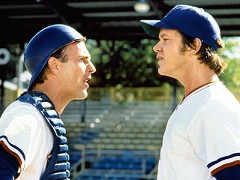
“This is a very simple game. You throw the ball, you catch the ball, you hit the ball. Sometimes you win, sometimes you lose, sometimes it rains.” Those are the wise words of Nuke LaLoosh (Tim Robbins), a promising young pitcher in the movie Bull Durham.

That advice was second hand, though. It came from Master Crash Davis (Kevin Costner), along with the Zen like practice of wearing women’s underwear. It all added up to Nuke rising through the minors to become the top prospect on the Durham Bulls.
Crash told Nuke, “You got a gift. When you were a baby, the Gods reached down and turned your right arm into a thunderbolt.”
But that wasn’t enough.
Nuke needed to break free from his way of thinking, break free from the physical and begin a different type of practice.
You Already Have A Practice
You already have a practice. Maybe a few of them.
Before you’re an NBA Champion, you’re a basketball player. And basketball players lace up their high-tops every day and hit the hardwood.
Before you’re a platinum recording artist, you’re a singer. And singers sing. In the car, at church, and around the house.
The quality of those daily practices make you the person you are.
And the flip side goes like this: middle aged, in middle management, with a bulging mid-section, and a midlife crisis, because of habits and practices that are, as the kids say, “mid.”
Mid is no way to live your life. But it’s easier, at least in the short term.
It’s easier to wait for your teacher or coach to bark orders at you. No ownership required, so you can point fingers at them when things don’t turn out as planned.
But having A Practice means you are doing the thing, regardless of what the coach says, regardless of the outcomes, and that puts the ownership on you. It’s a lot of responsibility.
Attending practice is about compliance.
Having a practice is about contribution.
If you want to be a creative person you can start by creating. Everyday. Not just when you have a recital.
So, you already have a practice. A slew of them. But the question is, how do they serve you? I have a Twitter practice that I’m not proud of. Thankfully I’ve managed to find some ballast in the form of books, writing, family, and sports.

We tell people we want this, that, and the other, but where are the receipts? Where is the work? The practice?
If you want to get strong, the basic recipe is pretty simple. Lift heavy things. Do it for 31 Easy™ minutes a day. Repeat for the next 12 months. You’ll be strong. All of that is simple, but what’s hard is creating that practice. Building a practice, not just attending practice, means that you’ll be changed. And change is hard.
In The Bhagavad-Gita, Krishna tells Arjuna, “We have the right to our labor, but not to the fruits of our labor.”
And if you want to change the fruits, you need to change the roots.
Others Will Notice
Blaise Pascal said, “All of humanity’s problems stem from man’s inability to sit quietly in a room alone.” He was onto something, but in reality, sitting quietly in a room is pretty simple. If you have a meditation practice, the real test is whether it transforms the way you show up outside of that room. A genuine meditation practice doesn’t stay on the cushion—it travels with you, wherever you go.
When you begin a meditation practice, you may feel different, but more than likely that change will come on so slow you won’t even notice. You’ll have moments of clarity, but you’ll also spend a lot of time wondering if the whole thing is a waste of time, if it’s “working,” if you’re “doing it right.” And really, if you are sitting and breathing and noticing, you are probably doing it right.
But something else will happen as well. Someday, you’ll be at the office, or at the game, and someone will say, “You are so chill all the time.”
You’ll be walking along, and someone will comment, “You never lose your cool, do you?”
And you’ll be surprised, because you have this vivid memory of the old you. The you that rifled your TV remote across the room, shattering it into a thousand useless pieces, because it was changing the channels a little too slow.
Don’t throw it to the wall, throw it through the wall.
In your mind’s eye, you see the pieces of that remote scattered across the floor. You feel the regret, the sinking feeling that only comes when you are forced to change channels on the actual TV like an animal.
But that’s not you anymore.
A deep practice creates ripple effects. Like Master Awa splitting that arrow, your practice will emerge through the darkness, and find its target. And others will notice the change even before you see it yourself.
That kind of practice becomes part of who you are, permeating every aspect of your life.
Even someone like Michael Jordan, who was so driven by negativity in his youth, who actively looked for slights, for chips to place on his shoulder, eventually realized a change in himself.
In the later stages of his career, he was able to live in the present, telling teammates to “put in the work and let the future emerge.” He’d finally shed the desire for a specific outcome.
Was he flawed? No doubt.
His Hall of Fame acceptance speech was petty, and cringeworthy. Leroy Smith, Buzz Peterson, Brian Russell, teammates and opponents from high school, college, and the pros were called out. They put “logs on the fire” that burned inside of Jordan. But that speech also had some gems. He said basketball was his refuge, his platform, and that being inducted was just a continuation, rather than the end, of his life in basketball. He warned the audience not to be surprised to see him playing at 50 years old. And he said, “Limits, like fears, are an illusion.”
That is a line that Master Awa would have embraced. Jordan wasn’t a Zen Master yet, but he’d found A Practice. Which leads us, the long way, back to Act 1 and Iverson.
Better, by Practicing?
“We sitting in here — I’m supposed to be the franchise player, and we in here talking about practice. I mean, listen: We talking about practice. Not a game. Not the game that I go out there and die for and play every game like it’s my last. Not the game. We talking about practice, man.”
A reporter asked Iverson if it was possible, that from Coach Brown’s perspective, the practice would be less about improving Iverson’s game than improving his teammates. It’s a valid question, especially when you know about Jordan and the Bulls.
Did Iverson reflect on that? Not even for a second.
“How the hell can I make my teammates better by practicing?!”

The 76ers inability to win it all in Iverson’s tenure had a lot to do with his inability to play with an orchestra.
I have no idea how often he missed practice. What I do know, simply from the way he talked about practice, was that he had less understanding than the beatnik busker about how to get where he wanted to go.
And Brown, a coach that helped Iverson reach his peak, wanted something even more for him. He wanted Iverson, and the team, to reach its potential.
Brown eventually left Philadelphia for Detroit. He won the 2004 NBA title there, coaching a scrappy, hardworking team, with no Hall of Fame players, and no heroes.
The best player on that Detroit team was Rip Hamilton, who was known as the best RUNNER in NBA history. He ran, and he ran, and he ran some more. He never stopped moving, with or without the ball, and he wore down his opponents through sheer hustle and grit.
Do you know what Rip Hamilton did every single day? He ran. True story. Look it up.
Larry Brown and Rip Hamilton both won titles at the college level and the NBA. Jordan did too. Iverson, not so much.
And it wasn’t because of talent, it was because of practice.
A practice.
If you enjoyed this post, please share it with a friend.









What do you think?