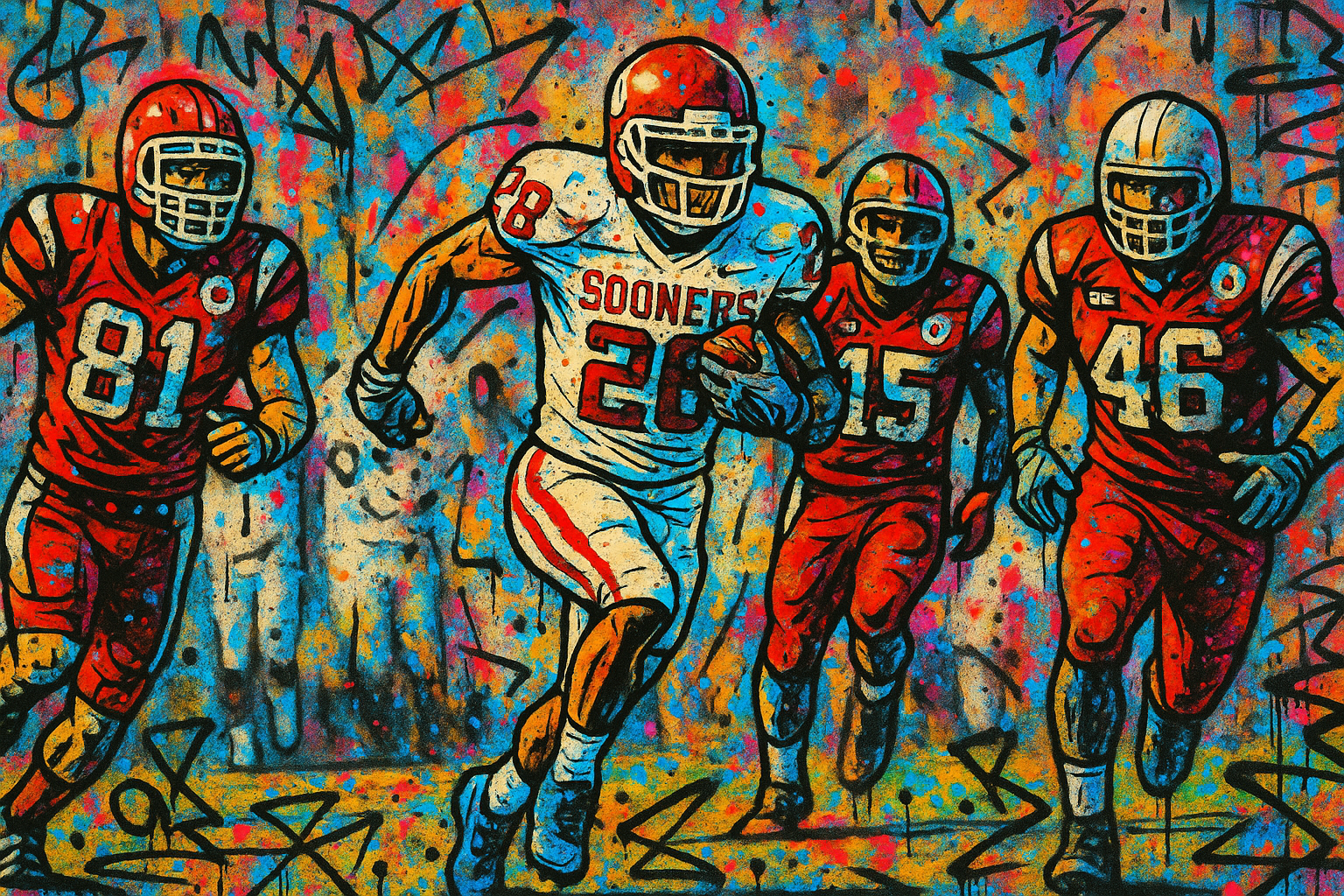
It was New Year’s Eve 2002 in Santa Monica, California, and we were ready to celebrate. After an 18-hour drive from Seattle, road-weary but excited to feel the sun, we set out along Pico Boulevard west towards the Pacific. The bars spilled onto the streets, each passing block just a bit livelier, and every soul we passed was draped in crimson.
The next morning, we’d shake off the cobwebs and head to Pasadena for the Rose Bowl, where my Washington State Cougars would face the Oklahoma Sooners. It was our second Rose Bowl in six years after an 80-year drought. So what if our quarterback was nursing a bum ankle. Who cares if our coach had just bolted for Alabama.
We were a program on the rise.
We were fired up.
And when you’re feeling that good, what do you do?
You talk some shit.
The Oklahoma Sooners, a blue-blood program, had rolled west to ring in the new year, though they weren’t thrilled about facing us. They’d been the nation’s number two team early in the season and had their sights set on the natty. But two late losses sent them tumbling down the BCS rankings, landing them in a New Year’s Day showdown with the fightin’ scrappin’ Cougars.
A group of older Sooner boosters strolled past our crew, and the banter began. My friend Justin leaned into it, tossing verbal jabs in their direction. It was cringe, but we were young, and it was all said with a wink and a smile—no malice.
One of their fans, an older man carrying a few extra pounds, didn’t take the bait. Without breaking stride, he glanced at Justin and our group and said, “just wait.”
No shouting, no arguing, and no need to get fanatical. He spoke with absolute certainty. As sure as the sun would rise in the morning, he knew that his Sooners would take it to us.
And in that moment, I knew it too.

The Roots of Confidence
That booster’s words echo a truth from Robert Pirsig’s Zen and the Art of Motorcycle Maintenance:
“You are never dedicated to something you have complete confidence in. No one is fanatically shouting that the sun is going to rise tomorrow. They know it’s going to rise tomorrow. When people are fanatically dedicated to political or religious faiths or any other kinds of dogmas or goals, it’s always because these dogmas or goals are in doubt.”
Fanaticism, Pirsig suggests, comes from insecurity. When you’re certain—like that Sooner fan—you don’t need to make a lot of noise. Arnold Schwarzenegger uses a different analogy, comparing a BMW to a Ferrari:
“When you have a BMW, which drives well although it’s not a great car, you try to race with everybody to prove that it has speed. But when you have a Ferrari or a Lamborghini you know you can beat anybody on the street. You don’t race any more. You start driving 55 on the freeway. Anybody can pass you and you know that if you step on the gas they’re gone. You know how good you are, you don’t have to prove it any more.”

Argument is a mask for insecurity, trying to convince the self as much as the other. In high school, every kid with a two-door Honda was spending their minimum wage on mufflers and subwoofers. You could hear them coming a mile away…but it was still a Honda.
Living the Lesson
Quiet confidence, when I see it, hopefully when I exude it, reminds me to question fanaticism. Whether in sports, debates, or professional settings, this principle holds true. In meetings, the person with the best ideas doesn’t need to dominate the conversation. In relationships, those most secure in their love don’t feel compelled to constantly prove it.
A true master doesn’t spend much time on their resume.
Walter Payton, one of football’s greatest running backs, understood this perfectly when he said, “When you’re good at something, you’ll tell everyone. When you’re great at something, they’ll tell you.” Walter kept pretty quiet.

If I’m shouting too loudly about a belief or goal, it’s a signal to pause and ask: What am I doubting? True certainty doesn’t need a megaphone. I’ve noticed that my most productive work happens when I’m not constantly seeking validation, my strongest relationships thrive without performative gestures, and my clearest thinking emerges when I’m not desperate to be right.
The results speak for themselves.
They always do.
Additional Resources
- Zen and the Art of Motorcycle Maintenance, by Robert Pirsig (Check it out)
- Arnold: The Education of a Bodybuilder, by Arnold Schwarzenegger (Check it out)
- Note on Affiliate Links
If you enjoyed this post, please share it with a friend.





What do you think?