All negotiations have a missing piece—just ask Walter White.
FBI negotiator Chris Voss says, “Negotiation is not an act of battle; it’s a process of discovery. The goal is to uncover as much information as possible.” Uncover something the other side doesn’t see, doesn’t understand, or doesn’t want to hear. Real negotiations involve change. Both sides are altered when the talks are done.
Let’s look at Breaking Bad, season one, episodes one, two, and three, for my favorite example.
Walter White and Jesse Pinkman have a big issue to deal with.
Domingo “Krazy-8” Molina.
Walt, a chemistry teacher, and Jesse, his former student, have just dipped their toes into the drug trade. And because of Walt’s background, their first batch of methamphetamine is unusually pure.
So pure, that Krazy-8 and his cousin Emilio Koyama want in on the action. Held at gunpoint, Walt agrees to show them his process, knowing they’ll kill him and Jesse once they learn it.
But Walt is not about to be outwitted by some dimwitted dealers. Using his chemistry expertise, he synthesizes phosphine gas, causing an explosion in their RV lab. He traps Emilio and Krazy-8 inside, asphyxiating them in the toxic gas.
Back at Jesse’s house, they’re surprised to see that Krazy-8 has survived. Using an old bike lock, Jesse shackles Krazy-8 around the neck to a pole in the basement. Krazy-8, still wheezing from the fumes, begins negotiating for his life.
Jesse knows Krazy-8 will kill him to save himself. And neither Walt nor Jesse are murderers—not yet. They flip a coin to decide who will handle Krazy-8. Walt loses, but he can’t bring himself to do it.
Lesson One: Everyone arrives at a negotiation with their own history. Their own baggage. And part of your discovery process is not just understanding the deal, but understanding the person you are dealing with.
Logic Fails Without Full Information
Being the practical man that he is, Walt jots down a pros-and-cons list for killing Krazy-8. He comes up with several arguments in support of compassion, while the sole entry in the Kill Him column is “He’ll kill your entire family if you let him go.”
Kill or be killed is a pretty high stakes negotiation.
While he wrestles with the decision, biding his time, Walt is treating Krazy-8 well.
Krazy-8 is telling Walt that he isn’t in the right business. That he doesn’t have this life in him. He is not a killer or a dealer, he’s a chemist.
Krazy-8 is right though. Walt doesn’t want to kill anyone. He pleads with Krazy-8, “Sell me. Give me a reason.” He is looking for a logical reason to let him go. Something he can explain to Jesse. Something he can explain to himself.
Lesson Two: Many negotiations follow logic. If this, then that. But it only works when dealing with parties where logic can be agreed upon.
When emotions run high or when we lack critical information, negotiators find themselves creating mental frameworks. Weighing costs against benefits, risks against rewards, only to have their carefully reasoned analysis crumble when faced with new information. What looks rational on paper rarely captures the full complexity of high-stakes human interaction.
Empathy Builds Trust — and Risk
On a trip to the basement, crustless sandwich in hand, Walt collapses, passes out, dropping Krazy-8’s sandwich and breaking a ceramic plate.

After waking, he cleans up the mess, makes another sandwich, and returns.
Walt opens up, revealing his lung cancer diagnosis. Krazy-8 shares that he’s the son of a local furniture-store owner, and Walt recalls the late-night commercials. He bought a crib for his son there. They bond over beers. Walt admits that he hasn’t told his family about the cancer diagnosis and Krazy-8 deduces that Walt is cooking meth so he can leave money for his loved ones.
Krazy-8 is becoming Domingo Molina and warns Walt that their talking won’t make killing him any easier.
Both men, after some initial posturing, are using empathy to build a bridge. Communicating. Even sharing details they wouldn’t share with their family or business associates.
Lesson Three: Find some truth. Amongst all the puffery and ulterior motives, this conversation was honest. It involved genuine interest, curiosity, and caring. Find that in your negotiations and you might find your way to a deal that works for all sides.
Domingo and Walt learn that they share the same desired outcome. Just one caveat, Walt would rather he and his family not die after the deal.

The Moment of Discovery: Information Asymmetry
Domingo tells Walt that he just wants to go home. No hard feelings. He reinforces that Walt is a good guy, not a criminal.
Walt, convinced, goes upstairs to get the key for the bike lock. But as he tosses a spent beer can in the bin, a thought occurs to him.
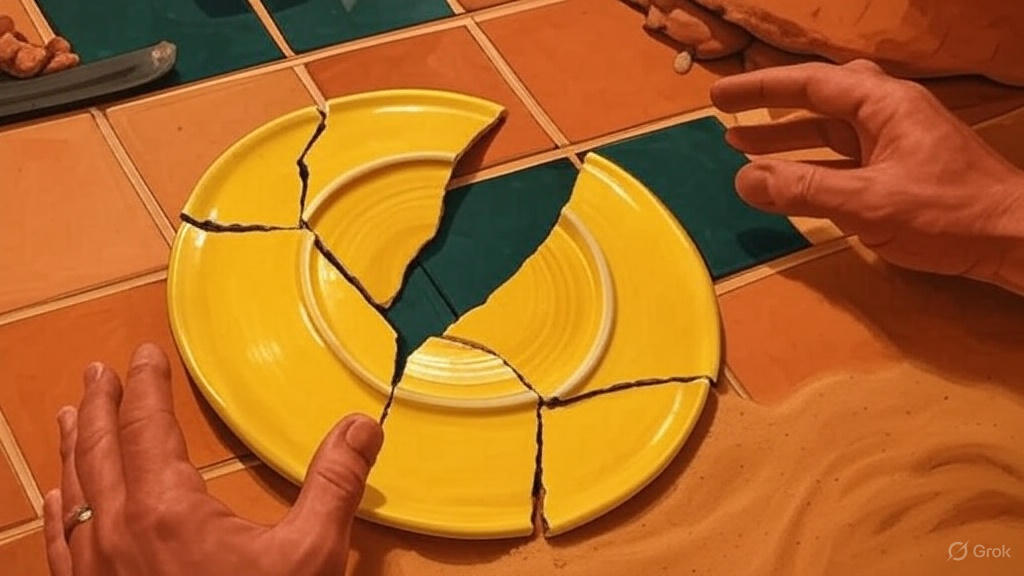
Inside the trash are the remnants of that yellow ceramic plate. The broken bits from his earlier fall. He’d tossed them in, hurried and somewhat embarrassed, without a second thought. And as he glanced in the trash one more time, it struck him.
He pulled the broken pieces out, and placed them on the counter, organizing them, putting the pieces together like a puzzle. And then he sees it. A piece is missing. Where could it be?
Of course he knows. He’s panicked. Panicked because of the deal he nearly made, and the outcome that deal would have produced.
“No. No. Oh, no, no, no, no. No. No. No, don’t do this. Why are you doing this? Why are you doing this?”

He checks the trash again.
It’s gone.
Lesson Four: Concealed information shapes power dynamics. Information asymmetry determines who holds the advantage in any negotiation. Once hidden facts are revealed, the balance of power shifts instantly.
Domingo’s mistake? He’d made a contingency plan that directly contradicted his negotiated agreement. Throughout most of the talks, he held crucial information that Walt lacked, giving him leverage. But when that information advantage suddenly flipped at the eleventh hour, his contingency plan—killing Walt—was exposed as completely at odds with the settlement he’d been negotiating in good faith. In that moment, all the goodwill he’d built up evaporated, because his true intentions proved he’d been negotiating dishonestly all along.
Negotiation’s Aftermath: Transformation
Walt returns to the basement where Krazy-8 is now standing up, still locked to the pole.
“You’re doing the right thing, Walter.”
“Yeah? Do you wanna?” Walt motions for Domingo to rotate around the pole so he can access the lock.
“So, you’re not angry.” Walt asks.
“What do you mean? Angry at you? No. Live and let live, man.”
“That’s very understanding.”
“Whatever, man. I just wanna go home.”
“Yeah. Me too.” Walt pauses. He can now see that Krazy-8 has something in his pocket.
“Unlock me, Walter.”
“The moment I do…are you gonna stick me with that broken piece of plate?”
Krazy-8 knows he’s found out, the deal is dead, and so is he. Walt pulls back on the bike lock, pulling it against Krazy-8’s neck and the pole.
“I’m sorry, I’m sorry, I’m sorry. I’m sorry, I’m so sorry, I’m so sorry.” Krazy-8 flails his arm, stabbing Walt in the leg multiple times.
I’m so sorry. I’m sorry. I’m sorry. I’m so sorry.” Walt’s apology is turning into a whisper as he suffocates the son of a furniture maker.
Breaking Bad, has a central theme. Transformation. And that is the central theme in negotiations as well.
“Chemistry. It is the study of what? Chemistry is… Well technically, chemistry is the study of matter.” Walt is waxing nostalgic in front of his class. “But I prefer to see it as the study of change. Electrons change their energy levels. Molecules change their bonds. Elements, they combine and change into compounds. That’s all of life, right? I mean it’s just the constant, it’s the cycle, it’s solution…dissolution. Just over and over and over. It is growth, then decay, then transformation. It is fascinating, really.”
The reason Walt looks at the plate and repeats “no, no, no,” is because he knows. He knows what needs to be done. He knows that he will be forever changed. The reason negotiations are difficult is because they change things too.
Transformation in negotiations, like in nature, often catches us by surprise. We resist it even as it happens to us.
Like the old joke, two caterpillars are crawling along when a butterfly flies by. One caterpillar turns to the other and says, “You’ll never catch me doing that!”
But transformation is inevitable in any meaningful exchange.
Lesson Five: Prepare yourself for change. Unless you are haggling over nickels and dimes at a garage sale, negotiations will leave both sides changed. But all too often we are not ready to be changed. We walk into a negotiation with a notion of compromise or winning. But what do we win? What did Walt win?
Understanding and preparing for change, can make negotiations easier to deal with.
Most deals aren’t life or death. But nearly all of them hinge on a missing piece—the overlooked fact, the silent assumption, the hidden intent.
Your job is to find it, whether you’re closing a deal or resolving a dispute, no matter how uncomfortable the truth may be.
The pros-and-cons list is incomplete until you have all the information.
Whenever I witness a negotiation, whenever I’m in one myself, I ask; Is there a missing piece? Surely there is.
Will it be consequential?
And that’s the lesson of Krazy-8 and the plate.
If you enjoyed this post, please share it with a friend.








What do you think?