People need help in different quantities. For some it’s a gentle nudge, and for others it’s a swift kick in the pants.
People need expertise, experience, and manpower.
What I do on most days is listen to problems, ambitions, and plans.
And I try to come up with a way to help. To be additive.
If it’s a big lift, we’ll get paid. A lot of the time it’s simple. Small. A lot of the time they have everything they need right in front of them. They just don’t know it yet. They need help seeing it. An upgrade to their process or perception.
The upside-down fire:
A good example of how this works is from Tim Ferriss and the upside-down fire.
Like Tim, I grew up making tipi fires. And I thought I was an expert at making them.

But Tim shared a new technique back in 2009 and I’ve used it ever since. The upside-down fire.
Same ingredients, new technique, better results. More heat, less smoke, less management, less ashes.
Sounds like a helpful solution to me.

Did Tim invent the upside-down fire? No. It was probably the Vikings or something. But he observed, tested, and shared.
Person A or Person B:
Better techniques can give you better outputs.

Are you person A or person B?
If you are person A, it would be nice if someone strolled down the beach and said, “Hey, I’ve seen this before. A lady just a few clicks down the beach named Person B took her HELP sign and made a raft.” For the sake of this post, we’ll call this someone walking the beach a consultant.
Of course, once the raft is built you may have all sorts of other issues to consult about. And that’s sort of how we get you into the sales cycle in my line of work. A bit of free advice, selling some transformation, and it turns into paid services. Or maybe we just have some beers and call it a day.
If you help someone with the raft, soon enough they’ll want to know how to get past the break and what direction to head once they do.
Inevitably the consultant will break out the PowerPoint, two-by-two matrix, and laser pointer.
And away we go.
Consultants might not know what it’s like to be stuck on the beach for 1,500 days. They might not know what it’s like to remove a tooth with someone’s ice skate or make besties with a volleyball, but they can tell you about others in the same situation. They can tell you all the others built a raft, went west towards the sunset, and found themselves a few days later, sunburned but alive, drifting through a shipping lane.
Rescued.
It’s making better use of what you have. To get you off that [figurative] island. To get you unstuck.
Process improvement based on what we have witnessed while poking around at other organizations.
So here I am feeling surprisingly good about myself and my career when Steve Jobs comes in, albeit from the past, and screws it all up for me.
What did Steve Jobs think of consulting?
Steve was not in love with the profession of consulting.
“How many of you are from consulting?” He asks a group from MIT.
Quite a few raise their hands.
“Oh, that’s bad. A mind is too important to waste. You should do something.”
I’ll assume Steve is primarily talking about management consulting or strategy consulting firms like McKinsey & Company or Bain & Company. The reputation of those firms is warranted. Consultant turned writer Richard Koch aired out the industry, saying “Bill Bain wasn’t really fascinated by the nuts and bolts of consulting. He was really interested in making money.”
Is that who you’d want snooping around your business?
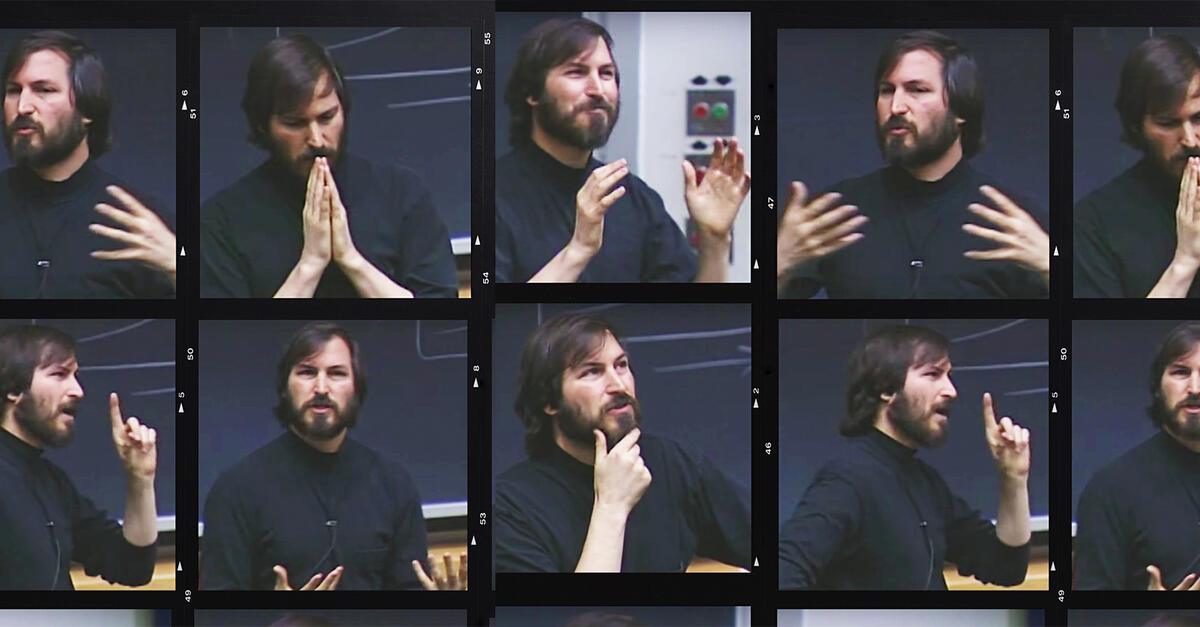
[Live footage of Steve Jobs, click it, really. Or just keep reading if you’re an overachiever]
“No seriously, I don’t think there’s anything inherently evil in consulting. I think that without owning something, over an extended period of time, like a few years, where one has a chance to take responsibility for one’s recommendations, where one has to see one’s recommendations through all action stages and accumulate scar tissue for the mistakes and pick oneself up off the ground and dust oneself off, one learns a fraction of what one can.
You’re coming in and making recommendations and not owning the results, not owning the implementation. I think it is a fraction of the of the value and a fraction of the opportunity to learn and get it better. And so, you do get a broad cut at companies, but it’s very thin. It’s like a picture of a, I’m a vegetarian so I won’t use steak, but it’s like a picture of a banana. You might get a very accurate picture, but it’s only two-dimensional, and without the experience of actually doing it, you never get three-dimensional. So, you might have a lot of pictures on your walls, you can show it off to your friends like I’ve worked in bananas, I’ve worked in peaches, I’ve worked in grapes, but you never really taste it. That’s what I think.”
Steve Jobs
And I’ll tell you what I think.
Steve is not wrong.
We’ve all felt it, trying to express the emotion and wonder of a place and time in two dimensions, like those pictures you took at the Grand Canyon. Nobody has any interest in them. They don’t mean much to you either, except for the fact that they bring back the memory. And the memory has all the sensory details and the story attached to it. That is the difference Steve is talking about.
Robert Pirsig touches on this in Zen and the Art of Motorcycle Maintenance.
“John gets his camera out. After a while he says, “This is the hardest stuff in the world to photograph. You need a three-hundred-and-sixty-degree lens, or something. You see it, and then you look down in the ground glass and it’s just nothing. As soon as you put a border on it, it’s gone.” I say, “That’s what you don’t see in a car, I suppose.” Sylvia says, “Once when I was about ten we stopped like this by the road and I used half a roll of film taking pictures. And when the pictures came back I cried. There wasn’t anything there.””
Zen and the Art of Motorcycle Maintenance, Robert M. Pirsig
But all that doesn’t mean the consultant can’t be helpful, right?
Because if you’ve worked with bananas, peaches, or grapes, you can probably recognize those items when held up against a box of rocks.
Groupthink, cognitive bias, tunnel vision:
What consultants see sometimes is a dog that thinks it’s a duck.
No three-hundred-and-sixty-degree lens is needed. Just a view from the outside.

Tarzan thought he was an ape. Simba thought he was a grub-eating warthog.
WeWork thought it was a technology company. Turns out they rent office space.
The frightening thing is the leaders in these companies believed it. Because they want to.
They fall into traps.
Groupthink. Cognitive bias. Tunnel vision. Whatevs.
Even if you don’t get a full taste of what it’s like inside those walls you can help provide perspective.
Jeff Bezos tells a story about the early days at Amazon. At that time, it was all hands-on deck to get the orders fulfilled and out to their new customers, and they were kneeling on the floor in their office.
“This packing is killing me! My back hurts, this is killing my knees on this hard cement floor,” Bezos exclaimed one day. “You know what we need? We need knee pads!” An employee looked at Bezos as if he were the stupidest person he’d ever seen. “What we need are packing tables,” he said. Bezos looked at the employee as if he were a genius. “I thought that was the smartest idea I had ever heard,” Bezos recalls. “The next day we got packing tables, and I think we doubled our productivity.”
Invent and Wander by Walter Isaacson and Jeff Bezos
It was Amazon’s first month of operation, and they had just ten employees at the time. It’s unclear who had the idea, maybe it was the UPS guy, but the point is that they didn’t need a decade of e-commerce experience to make an impactful suggestion. They just needed a different perspective.
New perspectives can help people make some awesome stuff.
The career consultant hasn’t learned less, they’ve learned different. They are generalists, so they learn less in-depth. A mile wide and an inch deep.
And that is enough sometimes.
We don’t always see the whole picture:
Even those with a singular focus don’t see the full picture on their own. Including Steve.
If you don’t want to take my word for it, I hope you’ll listen to Picasso.
“Recognizing Pablo Picasso in a train compartment, a man inquired of the artist why he did not paint people “the way they really are.” Picasso asked what he meant by that expression. The man opened his wallet and took out a snapshot of his wife, saying, “That’s my wife.” Picasso responded, “Isn’t she rather small and flat?””
Rosamund Stone Zander and Benjamin Zander, The Art of Possibility
This man, I presume, knew his wife quite well. But he had convinced himself that the flat image was a reasonable interpretation of her. More real than a Picasso painting at least. And Picasso helped him quickly see the error in his thinking.
Picasso didn’t need to know the man’s wife to provide a different perspective and improve the man’s perception.
For a related post that I really like but nobody else does, please see “are they funny?”





What do you think?