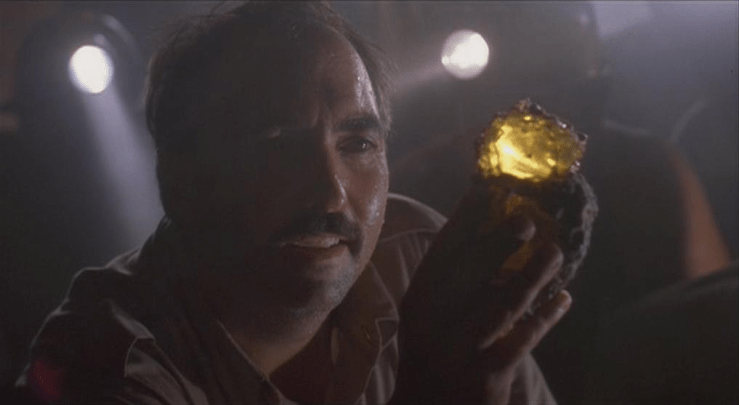
“T. rex doesn’t want to be fed. He wants to hunt. Can’t just suppress sixty-five million years of gut instinct.”
– Dr. Alan Grant (Sam Neill)
By feeding the dinosaurs, and fencing them in, Jurassic Park was attempting to suppress sixty-five million years of gut instinct. And fails in spectacular fashion. When you capture something, it’s just not the same. That’s why SeaWorld has you feeling nothing, but a snake in the grass makes the hairs on your neck stand on end.
T. rex and the other dinosaurs were created in a lab, but they had ancient DNA that was not meant for captivity.

Dr. Ian Malcolm (Jeff Goldblum) asked, “Now eventually you do plan to have dinosaurs on your dinosaur tour, right?” T. rex didn’t want to come out and do tricks for the park tour, and was not going to be pulled away from that gut instinct by a little mutton.
Being fed is no fun.
No hunt, no effort, no reward.
Do we share some of these same instincts?
Duck Hunt:
My son spent a good chunk of the summer in hot pursuit of something unbelievably valuable.
Ducks.
Not real ducks.
These little rubber ducks.

The most coveted prize you can earn at our local swim meets are little rubber ducks. They are awarded to swimmers of all ages that take first place in their heat.
The kids freak out. Bragging rights. Accolades. The ducks have real meaning.
After winning dozens and dozens of ducks over the years, an older swimmer might outgrow the little reward and decide that the work is the win. And that is exactly what happened when a middle school girl approached my son with a gift. She wanted to give him a duck.
He thought about it for a moment before (politely) declining. “Nah, ummm, I mean, no thanks,” he said. “It’s just not the same.”
The older girl nodded her head in agreement, “You’re right, it’s not the same.”
This same son comes home every day, walks past the fridge and into the back yard to pick blueberries. He likes the harvest.
Is it the novelty? Could be.
But maybe it’s something more.
Lazy:
Bill Gates said, “I choose a lazy person to do a hard job. Because a lazy person will find an easy way to do it.” But in this scenario, the “lazy person” is not such a sloth that they sit around eating grapes and fanning themselves until someone else does the work.
Gates is being playful with the term lazy. What he is really talking about is being efficient. Keeping things simple.
T. rex wanted to hunt but was a little ‘lazy’ as well. Instead of tracking down a Triceratops in the park, it took the easier route, snacking on the park lawyer, Donald Gennaro, while he was hiding out on the toilet.

Lazy.
And my son doesn’t make his life harder than it needs to be either. He doesn’t do the breaststroke during the 50 free. He doesn’t go out back and pick those berries while doing an interpretive dance, he just shovels them into his gullet, hand over fist.
Lazy.
I’ve always heard that our humanOS is coded to conserve energy. Prehistoric humans wouldn’t be into CrossFit, life was CrossFit, and tossing stones around to build a beach body was unnecessary. Better to save that energy for scavenging and self-defense, right?
So, is the lazy person an optimized version of human?
Not even close.
Shocking:
Most humans have a hard time just sitting around and doing nothing. Seriously, it’s true. In an experiment at the University of Virginia, participants were left in a room, alone, with nothing to do. It was a short fifteen-minute session. A chance for the participants to kick back, relax, or embrace a little boredom.
Oh, except they had one thing they could do. They had the option of giving themselves an electric shock if kicking back was not their jam.
Fun!
71% of men, and 25% of women gave themselves a shock. One badass dude actually gave himself 190 shocks in the fifteen-minute session.
Legend!
So, what gives?
It turns out, when you take this lazy thing to the extreme, it’s not really who we are. Like the T. rex, we enjoy a little something to keep us busy. It’s in our DNA. It’s a gut instinct.
“Every man looks at his wood-pile with a kind of affection. I love to have mine before my window, and the more chips the better to remind me of my pleasing work.” Henry David Thoreau describes the scene beautifully in Walden. “I had an old axe which nobody claimed, with which by spells in winter days, on the sunny side of the house, I played about the stumps which…warmed me twice—once while I was splitting them, and again when they were on the fire, so that no fuel could give out more heat.”
Chop your own wood and it will warm you twice.
Actually, three times.
Because it feels warmer having earned it. Thoreau noticed those wood chips, and was reminded of the work he put in, warmed by the experience, before the flames ever could.
Earn your turns:
“Have you tried uphill skiing?”
“Uphill?”
“Yeah, man. Uphill. Skip the lines by skinning your way to the top.”
A friend of mine spends most of his life in the mountains. He skis and snowboards in the winter. And although he has a seasons pass, the preference among him and the other diehards in the RV lot at Crystal Mountain is to “earn your turns.”
They use “skins” to transform their ski’s, allowing them to ascend without slipping.
Hike up, ski down, enjoy the mountain for all it has to offer.
And for a serious alpine tourist, going back to a chair lift is like child’s play. Like being offered a goat in a cage when your instinct is to hunt.
But not every skier wants to earn their turns and not every animal wants to hunt.
The key is paying attention to that gut instinct.
What has you feeling so unstimulated that you would rather shock yourself? When your mind wanders, what activity is it engaging in?
Wolfwatching:
In his beautiful poem, Wolfwatching, Ted Hughes describes a wolf living a docile existence in the middle of London. “Of all the things / To be in the middle of London, of all / Futile, hopeless things” he begins.
“He can’t settle. He’s ruffling / And re-organizing his position all day / Like a sleepless half-sleep of growing agonies / The day won’t pass. / The night will be worse.” This is existence without something that suits you and your gut instinct.
“He’s waiting / For the chance to live, then he’ll be off.” The wolf is dreaming of the opportunity to escape the well-kept, well-fed life.
For something easier? No.
“His every yawn / Is another dose of poison.” He continues.
“A million miles / Knotted in his paws. Ten million years / Broken between his teeth.” That ancient DNA is in there, waiting to be expressed.
And the feeling of dread, that without expression, the wolf will be just a two-dimensional version of itself, painted, “With eyes / Like doorframes in a desert / Between nothing and nothing.”
Damn, Ted.
I’m starting to think it’s not about a wolf.
And I’m starting to think Jurassic Park isn’t just about dinosaurs.
If you enjoyed this post, please share it with a friend.