Listen to this post: Apple Podcasts | Spotify | YouTube
I saw a photo of myself in the Bahamas, looking a little fluffy. I’d been brewing a lot of beer and drinking most of it. I knew I needed to get in shape. But how?
On the flight home, I downloaded Tim Ferriss’s The 4-Hour Body and found a chapter on ultraendurance. It detailed Brian MacKenzie’s approach to going from 5K to 50K in 12 weeks using sprints and intervals.

I’d always been a terrible runner. It was my kryptonite. At baseball practice, the coaches would make us race, and they’d pair me up with my buddy Tyler to see who was the slowest. It was embarrassing. But that’s exactly why I picked it. Maybe MacKenzie’s counterintuitive approach, weights and sprints instead of endless slow miles, was the missing piece.
I wanted to drop some pounds, but more to the point, I wanted to prove to myself I could do the hard thing. That I could follow through on the plan and make it to the finish.
Just one problem: the plan was twelve weeks long and the Seattle Rock ’n’ Roll Marathon was only ten weeks away.
I went for it anyways.
The race went well. I took my time. A slow, deliberate jog. I followed an old man for the last ten miles. He wore beat-up Asics and maintained a steady pace. My kind of guy. When I hit the home stretch, strangers were cheering me on, clanging cowbells, and I’ll admit—my eyes welled up. It was ten weeks of hard work culminating in a successful finish in 4:15. I felt completely full.
I collected my finisher’s medal and windbreaker and immediately signed up to run again the next year.
If I could do that with ten weeks, imagine what I could do with a full year.
As distance runners know, a full year is plenty of time…to get injured. Everything went wrong. I changed my training approach; I guess the MacKenzie method went too well. I was logging more miles and eventually pulled my calf. Then tweaked my back. Then my hips got so tight I could hardly stride. I was overtrained and breaking down.
But I’d told people I was doing it. The date was on the calendar and the training schedule pinned to the wall.
So I ran anyway.
Every step was pain. Toward the end I was counting strides—I’d muster one hundred running, then reward myself with fifty walking, then talk myself into another hundred. I finished in 4:10—five minutes faster after a full year of work—and I could barely walk myself to the parking lot for the drive home.
I felt empty.
Twelve months to gain five minutes. As the years passed, I found myself bringing up the experience in a variety of ways. The training, the injuries, and the race, left me with much more.
I think about that old man in beat-up Asics. How did his body last? I remember the morning runs in the rain, up before the sun, squeezing in the miles before work. Those training plans. The negotiations with myself to continue. And of course, the cheers from those strangers, helping runners down that final stretch.
What remains when a goal has come and gone?
Here are a few different answers.
The Path of Methodical Renewal
The Ship of Theseus

After Theseus returned from Crete—victorious over the Minotaur, hero of Athens—the city preserved his ship as a sacred monument. For over a thousand years, it sat docked in the harbor, a symbol of courage and identity.
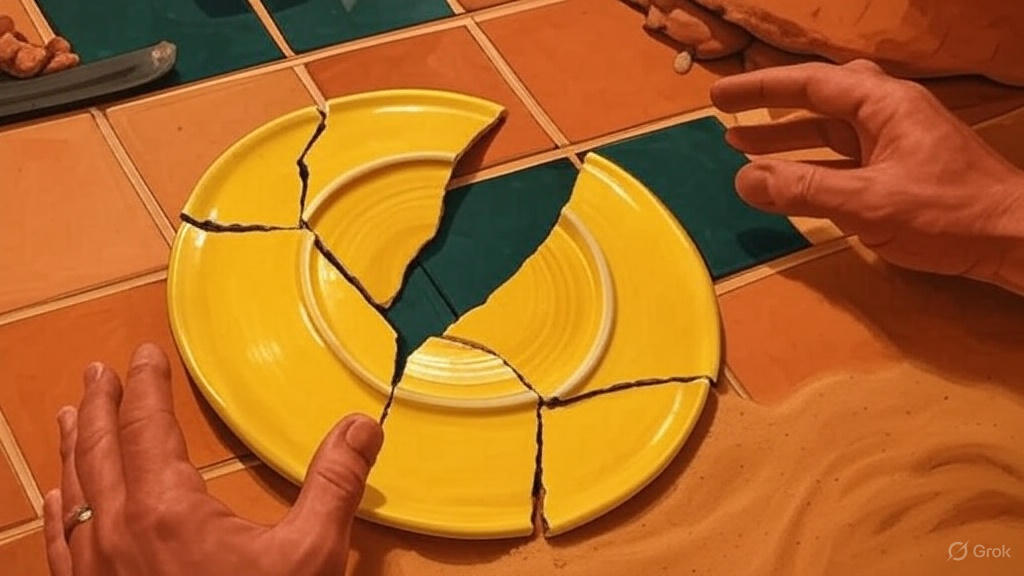
But wood rots. Rope frays. Sails tear.
So the Athenian caretakers began the work. One decaying plank here. A frayed rope there. A worm-eaten beam pulled out and replaced with fresh timber. Day by day. Year by year. Generation after generation of shipwrights showed up, did the work with no one watching, because they wanted the ship to sail.
Every year, Athens made a sacred voyage to Delos. They needed it seaworthy, not just symbolic.
With every plank, the caretakers faced a choice: let it rot, replace it with cheap wood that wouldn’t last, or fit strong timber worthy of the voyage. They chose quality because the work had purpose—to keep Theseus’s victory alive in the world, not just in memory.
Centuries passed. Every single original piece had been replaced: hull, mast, deck, rigging. Not one atom of the victorious ship remained.
Around 75 CE, the philosopher Plutarch stood at that harbor and documented what had become philosophy’s most enduring puzzle:
Is this still the ship of Theseus?
The question haunted Greek thinkers. Some said yes—it maintained continuity through purpose and form. Others said no—nothing original remained. And yet another thought emerged: what if someone collected all those discarded planks and reassembled them? Is that the Ship of Theseus?
The caretakers knew what the philosophers debated: you’re always changing. The question is whether you’re directing that change or drifting with it.
You’re not standing still. Habits decay or get reinforced. Beliefs ossify or evolve. Health slides or improves.
Will you pull the rotting planks? What will you replace them with? And why?
This is the work of methodical renewal: small, consistent acts of improvement that accumulate over time. Replace one habit. Refine one skill. Adjust one perspective—plank by plank. The change is subtle, sustainable, and preserves continuity.
Years later, you may look back and marvel at how completely you’ve evolved.
The daily act of choosing strong timber—the practice—is all we really have. The person who shows up, assesses what’s rotting, and does the work of renewal whether anyone’s watching or not.
But what happens when the work must be yours alone? When the goal vanishes and you keep going anyway?
The Path of Monumental Dedication
Burro Schmidt’s Tunnel

The ghost town of Cerro Gordo, a deserted mining settlement credited with funding Los Angeles’s transformation from a small California hamlet into a center of commerce and industry, sits east of Mount Whitney, above Death Valley.
In 1903, a miner named William “Burro” Schmidt decided to dig a tunnel straight through Copper Mountain instead of hauling ore along dangerous mountain trails.
A pick, a shovel, and a four-pound hammer was all he needed.
Every morning, he put on his boots and chipped away at solid granite bedrock. Some days he advanced feet. Other days, inches.
Years passed. Decades passed.
In 1920, workers built a road around the mountain. The original purpose of the tunnel—easier ore transport—vanished. It was no longer needed.
He kept digging. Someone needed that tunnel. The man inside it.
Thirty-six years later, Burro Schmidt broke through to the far side of the mountain. Only then did he discover his exit opened onto a sheer drop, unusable for hauling anything at all.
He had moved an estimated 5,800 tons of rock by wheelbarrow. The tunnel was six feet tall and ten feet wide, nearly half a mile long.
Then he did something unexpected.
He walked back through the tunnel, packed his belongings, and left. He never returned to Cerro Gordo.
No fanfare. No bitterness. Just the quiet knowledge of what he’d done.
We don’t know why he kept digging after the road came. Maybe he found ore. Maybe the work was its own type of victory. Maybe it was a compulsion.
But what remained?
When he left the tunnel, he understood something he couldn’t have known in 1903—something that comes with shocking rarity. He understood what he was capable of.
This is the work of monumental dedication. It involves choosing a task so large, so demanding, so audacious that it might take forever. It may never “work.” But the point is the work itself, so the task is done anyway.
You have the right to your labor, not the fruits of your labor.
It’s not efficient. It doesn’t guarantee success. And the outcome may be useless by any practical measure.
But what remains is unshakeable: proof that you can commit to something enormous regardless of whether it makes sense. The person forged by choosing, every single day, to continue—because the work matters more than the outcome.
The Path of Strategic Collaboration
Roger Bannister and the Four-Minute Mile

For decades, the four-minute mile loomed over the world of track and field—an unbreakable barrier that physiologists warned could strain the human body beyond its limits. Runners had grazed it, dipping to 4:01, but never below.
Many believed it impossible.
Roger Bannister, a 25-year-old medical student juggling hospital shifts with training, didn’t attack the problem by running harder. Instead, he attacked it by breaking it apart—and by asking for help.
First, he enlisted mentors. One coach helped him with his form, saying he’d shave twenty seconds if he’d just stop bouncing. Finnish coach Jaakko Mikkola taught him race-day rituals. Austrian coach Franz Stampfl shaped his training: intensive intervals instead of long distances.
He trained efficiently, squeezing forty-five to sixty minutes a day into lunch breaks. He broke the mile into pieces—mastered quarters and halves first, then layered endurance.
When progress stalled in early 1954, they adapted. What would it feel like to run a four-minute mile? Nobody knew. Bannister wanted to feel that tempo, so he found training partners who could pace segments of it, even if none could run that speed for a full mile.
On May 6, 1954, at Oxford’s Iffley Road track, everything aligned.
With pacemakers Chris Brasher (first half in 1:58) and Chris Chataway (third lap), Bannister drafted, conserving energy. As Chataway faded on the final lap, Bannister unleashed a 58.9-second closer—collapsing across the line as the announcer roared:
“Three minutes and fifty-nine point four seconds.”
Just forty-six days later, Australian John Landy ran 3:57.9. Within years, dozens followed.
What remains isn’t the record. It’s the work itself—the knowledge of how to break barriers by enlisting the right support, breaking a challenge into pieces, and executing with clarity.
It changes you by proving that limits aren’t as solid as they appear—and that you don’t have to face them alone.
What Remains
Three paths. Three ways of working.
One renews methodically, board by board—small, consistent acts choosing quality over decay.
One commits monumentally to something audacious—years or decades poured into work that might never pay off.
One breaks through strategically with support—enlisting mentors and partners to prove the impossible wrong.
My marathon doesn’t fit cleanly into any of these. Your goals and ambitions might not either.
Real life is a bit messier.
But knowing these stories has helped me reframe the things I go after.
Am I replacing rotting planks methodically, or am I Schmidt in that tunnel, proving something to myself alone? When you’re struggling, you can ask: do I need to break this down and find collaborators, or do I need to commit to the grind regardless of outcome?
The three paths are lenses. A way to see the work with more clarity.
I know what it feels like to be both full and empty at the same finish line. What remains isn’t the finisher’s medal, the windbreaker, or those five minutes on the clock. It’s knowing I can show up on cold mornings. That I can negotiate with pain and keep moving. That strangers will cheer for the work itself, not just the win.
The goal was to get in shape, lose some weight. I lost fifteen pounds—mostly muscle. By that measure, a failure.
But like Schmidt walking away from his tunnel, I left with something more valuable: I understood what I was capable of.
A year from now, five years from now—what will remain of the work you’re doing?
Not the applause. Not the moment of arrival. The residue. You, changed by the work.
So ask yourself: what kind of work creates the person you want to become?
When the calendar turns and the goal is gone, all you have is the work.
And the work is enough.
If you enjoyed this post, please share it with a friend.




What do you think?