Listen to this post: Apple Podcasts | Spotify | YouTube
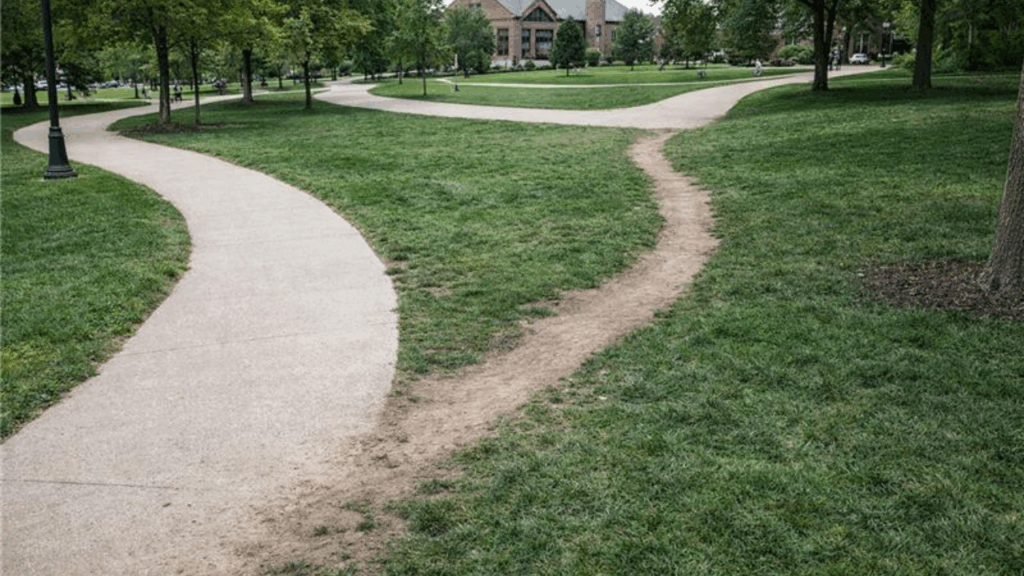
When Michigan State was building out its campus back in 1855, they didn’t have the money to pave the walkways between the buildings.
So they waited.
And what do you know—paths appeared.
Some were obvious: a straight shot from one hall to the next. Others made no sense at all, until you walked them yourself. A curve, bending through the afternoon shade. Another, sliding wide around a murder of crows.
Only then, with the knowledge of a thousand steps, did they pour the concrete. They let the trails tell them where the sidewalks wanted to go.
That’s a desire path. The route you reveal.
You can see the same approach at UC Irvine. Pull up a map of Aldrich Park, the circular green at the heart of campus. During construction they poured a clean ring around the outside and left the inside bare. Soon enough, a tangle of paths appeared.
It’s the kind of thing you can only really see from above.

And this isn’t just for hoity-toity college types. It’s for all human types. And it goes back a long way.
If you ever find yourself in Manhattan, as I have, walking down Broadway—you’re walking a desire path. A line the Lenape wore into the island before anyone mapped it. They followed a ridge of high, dry ground, footing that stayed solid when the lowlands turned to mud. The Dutch came and widened it. The British came and renamed it. When the city snapped its open land into a grid in 1811, Broadway bucked the trend.
It still cuts that stubborn diagonal across the numbered streets—and now you know why…didn’t even have to take one of those bus tours. Four hundred years of walking, and we still take the low-land-dodging, swamp-avoiding, mud-escaping route from Union Square to the Upper West Side.

The walker always has a reason, even when you can’t see it from a distance. A shortcut. An obstacle. Local superstition.
But are we really talking about trails through parks today?
No. Not really. We’re talking about trails through time. Through life.
Some of us seem to spot the path before they’ve taken a step. They can walk up to an open space and pick a route—see a line through the grass where none exists.
And damn it, I want to know why.
Dr. Dre’s mother says that as a baby, he’d lie down by the speaker and stare up into the air, like he was searching for the notes. Before he could read, he knew which records to play at a house party.
He knew the way. His way.
Found the path early and never stepped off. That takes a mixture of skill and luck and dedication. Makes me super jelly.
Then there are those who find their way by taking the worn path. The paved path. We call them accountants.
And there’s nothing wrong with that.
Broadway is a gift. Somebody wore that line for a damn good reason, and now you get to walk it dry-footed while everyone else wanders into the marsh. If the paved path goes where you want to go, take it—you’d be a fool not to.
But there’s a third kind of person out walking the land. Can’t pick a fresh line out of the clear blue and can’t stomach the paved one either. They feel a pull to make their own way, but try as they might, they can’t quite see it. No prodigy’s vision. No conformist’s compliance. They’ll walk Broadway for a bit, but all the while, they’re checking every side street.
I walked the worn path for twenty years and never felt so lost.
So how do you find your desire path?
You’ve got to do some walking. You’ve got to pay attention. But mostly, you’ve got to wander. For a long time. Down the wrong paths.
Vincent van Gogh spent his twenties on the wrong path—all the while, brushing past the right one every day. His first real job was with an art dealer, Goupil & Company, where he packed paintings and sold other people’s work. The Hague, London, Paris. Years of it. He was, by every account, a terrible art dealer—too awkward with customers, too far inside his own head.
So they let him go.
And then he picked up a brush and lived happily ever after, right?
Wrong.
He tried teaching. Failed. He tried preaching. Failed at that too. A stint as a bookseller went no better. Every paved road took him farther from the canvas.
He didn’t commit himself to art until he was twenty-seven—broke, rejected, a disappointment to his family.
Julia Cameron calls this a shadow career. The work you take up that sits right next to your calling—adjacent to it, parallel to it—but never the thing itself.
Steven Pressfield lived one for decades. He drove trucks and picked fruit. Eventually he got closer—advertising copy, then screenplays, brushing right past the real thing. All the while, he knew it was hiding.
So what finally gets a person off the shadow path and onto their own?
A bit of age and experience can help.
An old man taught me this in the most remarkable way.
He was sliding down the pew at church, one careful step at a time, when he began releasing what can only be described as a metronomic series of farts.
Step.
Errrpp.
Step.
Brrrp.
Step, step.
Errrpp, brrrp.
Nothing explosive. No grand finale. This man was not making a show of things. He was consistent. Like a session drummer.
By the time he’d reached his seat a light atmospheric haze had covered three rows of parishioners, who suddenly found prayer, a retreat to lower altitudes.
We called it “the walking farts,” and still do.
Why do I share this story on an otherwise serious blog? Because this scene just does not happen to a man at twenty-three out looking for a job. At twenty-three, you pinch the cheeks so to speak. You can grin and bear it. You can pretend.
Eventually, something gives.

As we get older, the masks slip, the filter loosens, and the psyche starts pushing us to become more of who we already were. Carl Jung calls that next step in life, individuation.
Pressfield’s version was less odiferous. He scraped together a little money, holed up somewhere cheap, and gave himself an ultimatum. He told himself, I’m going to finish this son of a bitch, or I’m going to kill myself.
He finished. He is still with us. Still writing.
The book never sold. Didn’t matter—typing those words, The End, had already shifted something.
He was on the path now. His path. He was a writer.
It would just take eighteen years of walking to arrive at The Legend of Bagger Vance.

Wandering is how desire paths begin.
But eventually the wandering has to stop.
At some point you have to look back at the trail you’ve been leaving and admit what it says about you.
Finding that path requires some private investigation. You’ve got to collect the evidence.
A desire path gives up its secrets two ways. From down low. And from high above.
Start low. Riccardo Marini wanted to know where to put the benches in London. He didn’t hire consultants or read up on the latest research. He got down and catalogued the dropped gum and cigarette butts across the city—reading where people stopped, stood, socialized, and took their breaks.
You can do the same.
Get down low. Really low. Find the litter, the breadcrumbs, the bubble gum. Where does it pile up?
What do you read, write, make, and talk about when nobody’s pushing you? What do you keep drifting toward?
That thing we call a midlife crisis—the sports car, the sudden hard left—it’s not a breakdown, not most of the time. It’s a survey. A person who’s been on the same path so long they’ve forgotten how to cross open ground. So they yank the wheel.
Better to get down on their hands and knees in the grass, try to read the tracks they’ve been leaving for years.
Then get high. Because, like Aldrich Park, some paths are easier to see from above.
John Muir didn’t know his path at twenty. So he walked. After nearly losing his eyesight in an accident, he decided to see whatever beauty he could. A thousand miles on foot from Kentucky to the Gulf, then to Cuba, and eventually, the long way round to California and Yosemite. He spent years in that valley, then went away again. Alaska. Washington State and Mount Rainier.
And back again.

He married, raised a family, tried to settle into a different life, running a successful orchard. But every time he walked away, something kept drawing him back to that valley.
His wife saw it. Physically, he grew frail as he worked the farm. She pushed him to go back into the mountains, and when he did, his vigor returned.
Eventually, he founded the Sierra Club, lobbied in Sacramento and Washington DC, and spent the rest of his life fighting to protect the places that had made him feel alive.
Step back far enough from his life and one line stands out above the rest.
It always led back to Yosemite.
Sometimes you have to get low enough to see the footprints. Sometimes you have to get high enough to see where they lead.
When I started this blog, there wasn’t much to see. No footprints. No worn grass. I was still wandering. So I just wrote.
Sales, and then business. A bit of psychology and personal development. Was that really it?
WordPress kept a tally—a word cloud that scooped up my most-used tags and put them right back in front of my face. An aerial view.
AI Amazon Authentic Business Charlie Munger Coaching Communication Creativity Customer Success Dave's Favs David Ogilvy Elon Musk Entrepreneurship Family First Principles Frameworks Goals Habits Improvement Jeff Bezos Jerry Seinfeld Judgment Leadership Marketing Naval Ravikant Parenting Personal Development Practice Productivity Psychology Risk Ryan Holiday Sales Seth Godin Stephen Covey Steve Jobs Steven Pressfield Success Systems Tim Ferriss Transparency Trust Warren Buffett Wise Writing
Trust. Judgment. Perception. Wayne’s World.
Yep, that’s me.
I’d been walking that path for a year before I could see what I was carving.
Rebecca Solnit wrote that “walking is a mode of making the world as well as being in it.” She wasn’t being cute. It’s literal. The rare few can see the line before they take a step, like Dr. Dre. The rest of us have to walk it into being.
You find it by moving—and paying attention to what keeps pulling you back. The maps, as drawn, won’t have those details.
A desire path is a record. It’s where you go when nobody’s telling you where to go.
And eventually, if you look down often enough—and step back far enough—you’ll see the path you’ve been carving all along.
If you enjoyed this post, please share it with a friend.





What do you think?