Listen to this post: Apple Podcasts | Spotify | YouTube
Baseball players are a superstitious bunch. Rituals surround the game.
Hall of Famer Wade Boggs earned his nickname “Chicken Man” by eating poultry before every game.
Turk Wendell brushed his teeth between innings.
When facing a serious batting slump, Jason Giambi would break out his lucky golden thong.
And outfielder Moises Alou peed on his hands during the season.
Those guys were negotiating with the randomness of the world—trying to control outcomes that can’t be controlled.
The stories I’ll share are focused on something you can control. Who shows up. They’re about your identities, all of them. And the risk of not knowing where one ends and the others begin.
Let’s start with the tail of a well-known and well-liked player, a future Hall of Famer, who had a brief conversation every time he came and went to the ballpark.
Who did he talk to?
Himself.
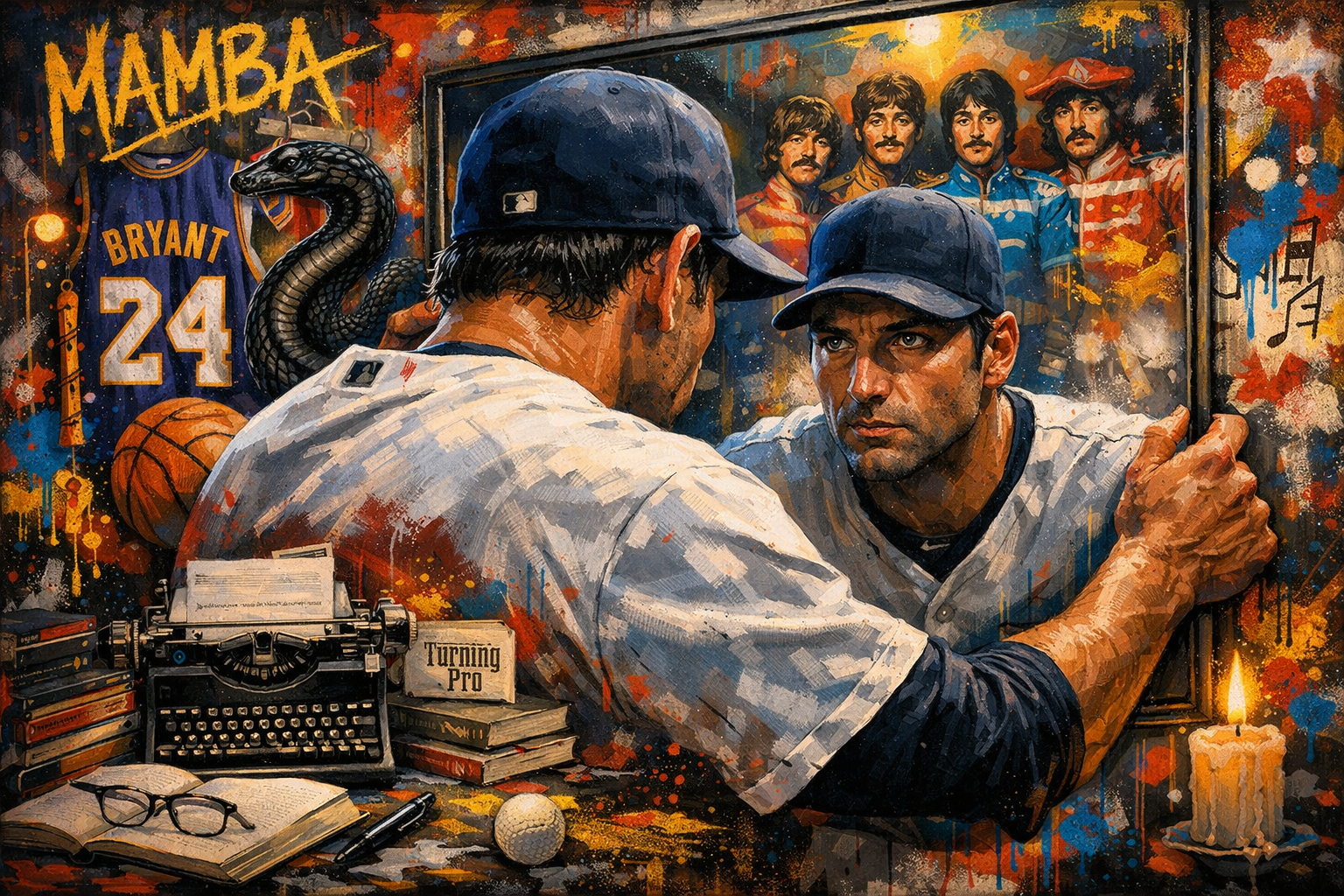
Upon arrival, before changing into his gear, he’d find a mirror, he’d look at his reflection, right into his eyes, and say, “It’s good to see you.”
That was the greeting. The start of his workday. He was clocking in. He was checking in with himself. At least, a version of himself.
Before he’d leave the ballpark, he’d walk up to that same mirror, look at himself again, and say, “See you tomorrow.”
Then he’d leave. Not as a ballplayer. Just as himself.
There’s a myth about elite performance that goes something like this: to be great, you have to become your work. Live in that skin full time. Grind. Hustle. Sleep when you’re dead. Your identity and your craft need to be indistinguishable.
This Hall of Famer knew something different. The best don’t merge with their work. They greet it. They deploy it. They tap into it.
That mirror was a threshold, a portal, like walking through the back of a closet into Narnia. The man on the other side—the one who could hit a ball 500 feet—was a tool. A version. One he couldn’t live with full time.
“See you tomorrow.”
A Psychological Commute
In Turning Pro, Steven Pressfield describes a lunch box mentality. Professional habits are not always easy. Sometimes you just tie up the work boots and trudge off into the mine. Clock in, do the work, and see what comes.

Pressfield had his own ritual. Not a conversation, but a commute. For many years he wrote in the “little house behind the big house”—a Spartan, detached studio in the California hills. To get there, he would take a short walk, up a trail, through the chaparral. A psychological commute more than anything else. Used to mentally prepare for the daily battle with Resistance.
This physical separation between his “living” space and his “warrior” space was a cornerstone of his philosophy.
On one side of the trail was Steven the citizen, the spouse, the friend. But as he moved through the scrub and dry brush, he was crossing a threshold. By the time he reached the door of that “shack,” he had shed the civilian. He was clocking in.
Inside that one-room office, the atmosphere changed.
“I have my list of approved players,” he wrote. “Dostoevsky, Tolstoy, Hemingway, Mark Twain, Virginia Woolf, Melville, Faulkner, Fitzgerald, Chekhov, Harper Lee, Philip Roth, Saul Bellow, Homer, Plato, Xenophon, Shakespeare, King David…. I’m not inviting them into my living room to watch TV; I’m meeting them at the job site.”
That shack was his locker room and the ball field. The statue of Nike on his desk and the “approved players” on his shelf were his teammates. His coaches. When he “put his ass where his heart wants to be,” he could become a writer. Better still, The Professional Writer.
When the work is done for the day, he leaves the players behind. He walks back through the brush and returns to “the big house,” where laundry, dinner, and the duties of normal life await.
The lunch pail goes back on the shelf. Ready for tomorrow.
Who is the Black Mamba?
Kobe Bryant didn’t invent Black Mamba. He just applied it to the cold, obsessive, ruthless part of himself that showed up on the court, and was bleeding into other parts of his life. Once it had a name, he could compartmentalize. Control when it came out. And more importantly, when it went away.
He said, “There is a difference between who you are and what you are.”
Kobe the person was a teammate. A son. Eventually a father and a coach. He felt slights. He cared about people’s opinions. He carried history, expectations, baggage.
Black Mamba was something different.

Inspired by the deadly assassin in Quentin Tarantino’s 2003 movie Kill Bill, Bryant told The New Yorker, the alter ego “separates the personal stuff.”
Mamba didn’t need to be liked. He didn’t need to explain himself. He didn’t feel guilt for taking the last shot or freezing out a teammate who wasn’t locked in. The mask stripped away social friction and left only execution.
When the jersey went on, so did the skin. When the game ended, he could take it off.
Becoming Mamba wasn’t the hard part for Kobe. Leaving him at the arena was.
“Let’s Not Be Ourselves.”
The most creative version of this principle came from four guys in Liverpool who were suffocating under the weight of their own success.
By late 1966, The Beatles were exhausted. The mop-top image. The screaming fans. The expectations. They’d stopped touring, but had they dried up? Run out of ideas? In reality, they were stuck—not creatively, but psychologically. They couldn’t move forward while dragging their own mythology behind them.
“Let’s not be ourselves,” McCartney told the others. “Let’s develop alter egos so we don’t have to project an image. It would be much more free.”
The West Coast psychedelic scene had caught Paul’s ear—not just the sounds, but the names. Big Brother and the Holding Company. Quicksilver Messenger Service. Long, elaborate, fanciful. Who were these people? The idea of becoming someone else entirely took hold, and eventually landed on Sgt. Pepper’s Lonely Hearts Club Band—a fictional Edwardian military band who would “perform” the album.

The disguise worked. Freed from being The Beatles, they became experimental, adventurous, weird. Tape loops. Orchestras. Sound effects. Indian instruments. Vaudeville. The album broke every rule. It wasn’t the Beatles—it was new and different. It was unbound.
When it released in June 1967, the world lost its mind. The philosopher Langdon Winner recalled driving across America on Interstate 80: “In each city where I stopped for gas or food—Laramie, Ogallala, Moline, South Bend—the melodies wafted in from some far-off transistor radio or portable hi-fi. It was the most amazing thing I’ve ever heard.”
Sgt. Pepper is often called one of rock’s first concept albums. But the real innovation was psychological. McCartney had found a way to shed the crushing weight of being the biggest band on Earth. He convinced the guys to come with him. And they unearthed something that could never have come from The Beatles.
***
There’s a version of this idea that shows up in self-help books: Create an alter ego and unlock your hidden potential! From Bruce Wayne to Batman, in 10 simple steps!
As if the right persona is a cheat code for greatness.
But look at who actually did this.
The Hall of Famer was already a major league ballplayer. Kobe was already an NBA champion. The Beatles were already the biggest band on Earth. Pressfield was already a novelist.
None of them adopted an alter ego to become successful. They were already successful.
The alter ego isn’t a recipe for getting there. It’s a tool for surviving altitude sickness.
Kobe’s competitiveness, his obsession, his emotional detachment—without a container, those traits consume everything around it. Black Mamba gave him a way to deploy the intensity without letting it leak into every relationship, every room, every moment.
The Beatles’ mythology—the screaming fans, the expectations, the sound the world demanded from them—was the direct result of their success. Sgt. Pepper helped them survive their success, to transition into a second act, and to continue creating without the weight of the world on their shoulders.
Pressfield’s trajectory was different. He walked that trail to write fiction—Bagger Vance, Gates of Fire—but somewhere along the way, the journey became the treasure. In Bagger Vance, a struggling golfer is guided by a mysterious caddy, a Krishna figure who teaches him to get out of his own way. Years later, Pressfield became that figure for writers. The War of Art. Turning Pro. The shack, the ritual, the battle with Resistance—he walked the hero’s journey, then came back to teach it.
These figures learned the hard way—that the qualities which got them to the top would eat them alive if they couldn’t create some distance.
I tell my Little League teams, “you don’t need to be the same person on this field that you are at home, or in the classroom.” And what surprises me every season is that the threshold works both ways. Some kids need to find their Mamba between those chalk lines—the version of themselves that’s fearless, locked in, a little bit nasty. But others? They show up already wearing the armor. The field is where they finally get to take it off. That same threshold, below swinging doors.
Elite performers figured this out. The ones who last, anyway. They don’t live in the skin 24/7. They greet it in the morning and release it at night.
“It’s good to see you.”
And when the work is done:
“See you tomorrow.”
If you enjoyed this post, please share it with a friend.








What do you think?