Listen to this post: Apple Podcasts | Spotify | YouTube
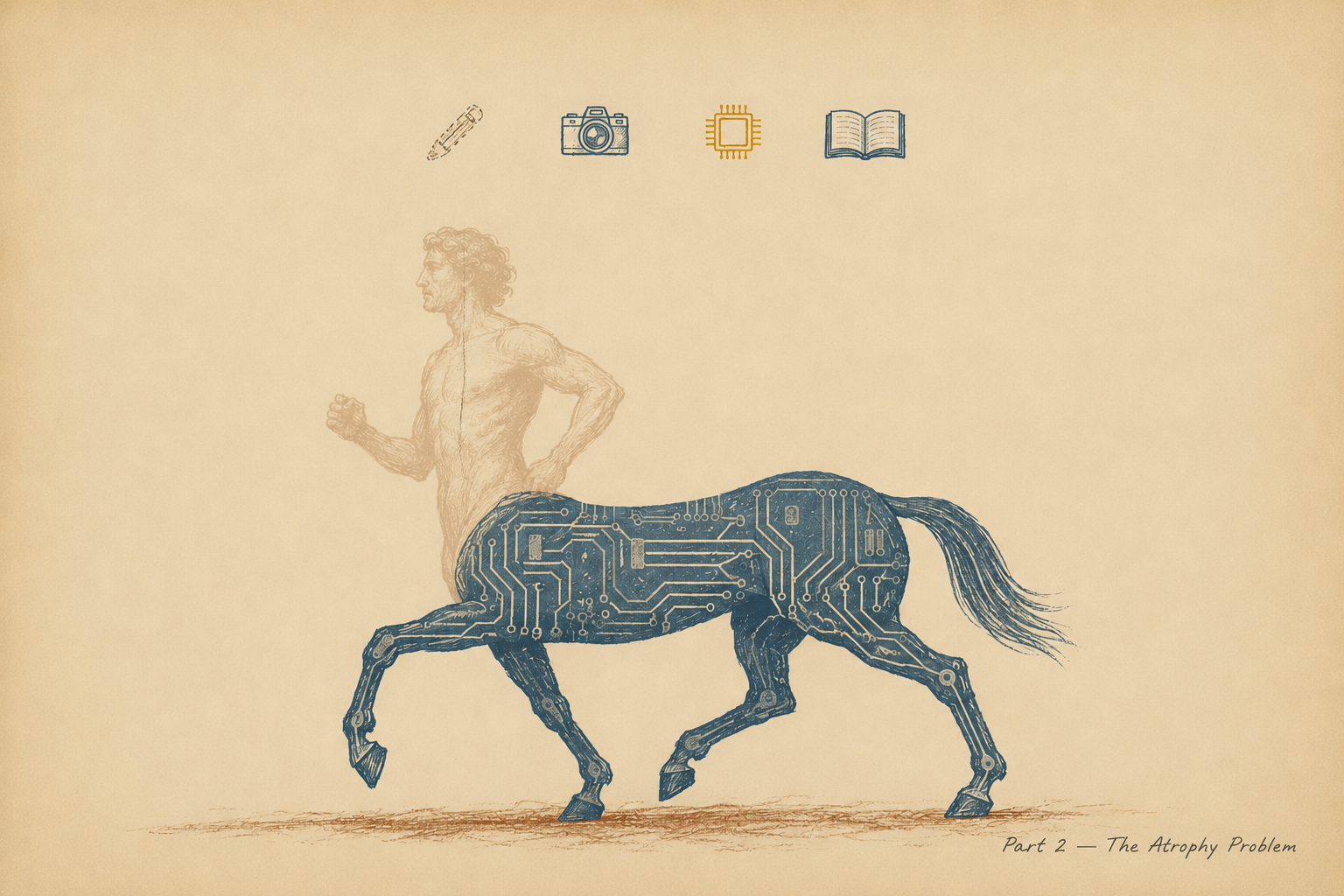
A five-part series on working with the robots. Part 1
On April 14, 2026, the Artemis II splashed down in the Pacific after its lap around the moon. The crew had traveled deeper into space than any human ever had. They’d rekindled the desire to explore, to search deeper into space, and to return to the moon.
The training for this mission was rigorous, more so than its Apollo predecessors. For nearly three years, the four-person crew went through it all: Orion simulators, T-38 jet training, geology field expeditions in Iceland and Hawaii, emergency egress drills, and countless hours on a custom-built flywheel resistance machine designed specifically to keep their bones and muscles from wasting in space. NASA knew the body breaks down up there. They prepared for it.
And even so, only Victor Glover walked off the deck. The other three needed support.
Reid Wiseman, Christina Koch, and Jeremy Hansen—three career astronauts—needed Navy crews to wheel them out.

Ten days without gravity, ten days without bearing weight, and three out of four were carried off the ship.
Their leg muscles had atrophied. From able-bodied to not. In just ten days.
Your brain works the same way.
Researchers at MIT wanted to take a closer look. In 2025, Nataliya Kos’myna and her team wired up 54 adults with EEG headsets and asked them to write essays—some using ChatGPT, some using a search engine, some with no tools at all. Over four months, the group using ChatGPT showed the weakest brain connectivity. By the end, they weren’t really writing essays at all. They were copy-pasting. The researchers called it “cognitive debt.” When the ChatGPT users were moved to the no-tools group for a final session, their brains still couldn’t quite engage. The effects lingered.
Ten days on the Dragon, ten days without bearing weight, and legs stopped being legs. Four months of letting AI write your essays, not holding ideas in your head long enough to shape them, and the idea muscle wasted accordingly.
Convenience removes the lift, it removes the burden, and in short order, it removes the ability.
Try to be funny when you can’t come up with words. Try to be useful when you can’t construct a coherent thought.
What robot is going to want to “+” you?
The Lost Sense of Direction
A few weeks ago, my son and I were on our way to REI. He needed an inner tube. I needed nothing—I just love going to REI, but that’s beside the point.
We were chatting and listening to music and I missed my turn. So we bobbed and weaved through a few neighborhoods. A few more wrong turns, all in the general direction of REI but not optimized. And we made it.
At each wrong turn, my son would gasp. “Why don’t you just use Google Maps?”
“Because I know the way.”
And of course I did know the way. Not turn by turn, but the direction. It worked. But to his generation, every route has been plotted, measured, color-coded, and optimized. A sense of direction has been lost. A basic human survival skill, squashed.
For most, basic navigation isn’t a skill they’ve honed. It’s just the residue of paying attention. The landmarks, the cardinal direction, the relationship between intersections. Over time you get a feel for it. You sense the downhill slope towards water, the direction of the rising sun, the proximity to mountain peaks.
But take the attention away and the skill never forms.
When the tires are pumped, it’s an amazing thing to ride bikes around town and watch him see things for the first time. Watch him understand that there are different ways to get where you’re going.
You can almost see his brain growing in real time.
Train the Muscle
The fix is unsexy: practice paying attention.
Sit in a theater with one screen, no phone. Read a real book, all the way through. Meditate. Climb something. Take batting practice. Write down 10 ideas a day. Cook a meal that takes three hours. Go for a long walk without a podcast. Watch Jeopardy and shout answers at the TV.
Any activity that asks you to hold something in your head longer than a TikTok video.
What’s wasting the muscle is the opposite—YouTube Shorts, infinite scroll, multitasking. Each one is a small surrender. They add up to a brain you can’t trust in a pinch.
These practices do something else too. They give your mind the kind of long, quiet space where ideas have time to collide. The book talks to the problem you’re sitting with. The walk surfaces the thing you couldn’t think of at your desk. The shower delivers the answer the laptop wouldn’t.
Notice that convenience kills the conditions where those collisions happen.
Jerzy Gregorek said it best: “Easy choices, hard life. Hard choices, easy life.”
The robots can translate any language for you. They can also teach you any language. The robots can take on your manual work. They can also work alongside you. Same tool, two completely different uses.
Resistance training isn’t just for the gym. It’s for the psyche. Train yourself to resist the easy choice, knowing the easy choice leads to a hard life.
Stay capable of doing the inconvenient.
Then—once you’ve kept your edge—you can pick up the robot.
But take the first swipe. Create your version, then bring it to the robot for suggestions. Never the other way around.
Because once the robot has created a draft, a prototype, you can’t unsee it. It’s very difficult to come up with something new and different after that kernel—that seed—has taken root. You’ll think oh, that sounds sharp, looks pretty good, that will do the trick. And when you return a day or two later, you’ll wonder who the hell came up with it, and why.
But by then, the seed is planted. Your own thinking has been pre-empted.
So: draft first. Always.
The “+” weakens when humans stop carrying a cognitive load.
And there’s a specific kind of load only humans can carry.
If you enjoyed this post, please share it with a friend.





What do you think?