Today is the day.
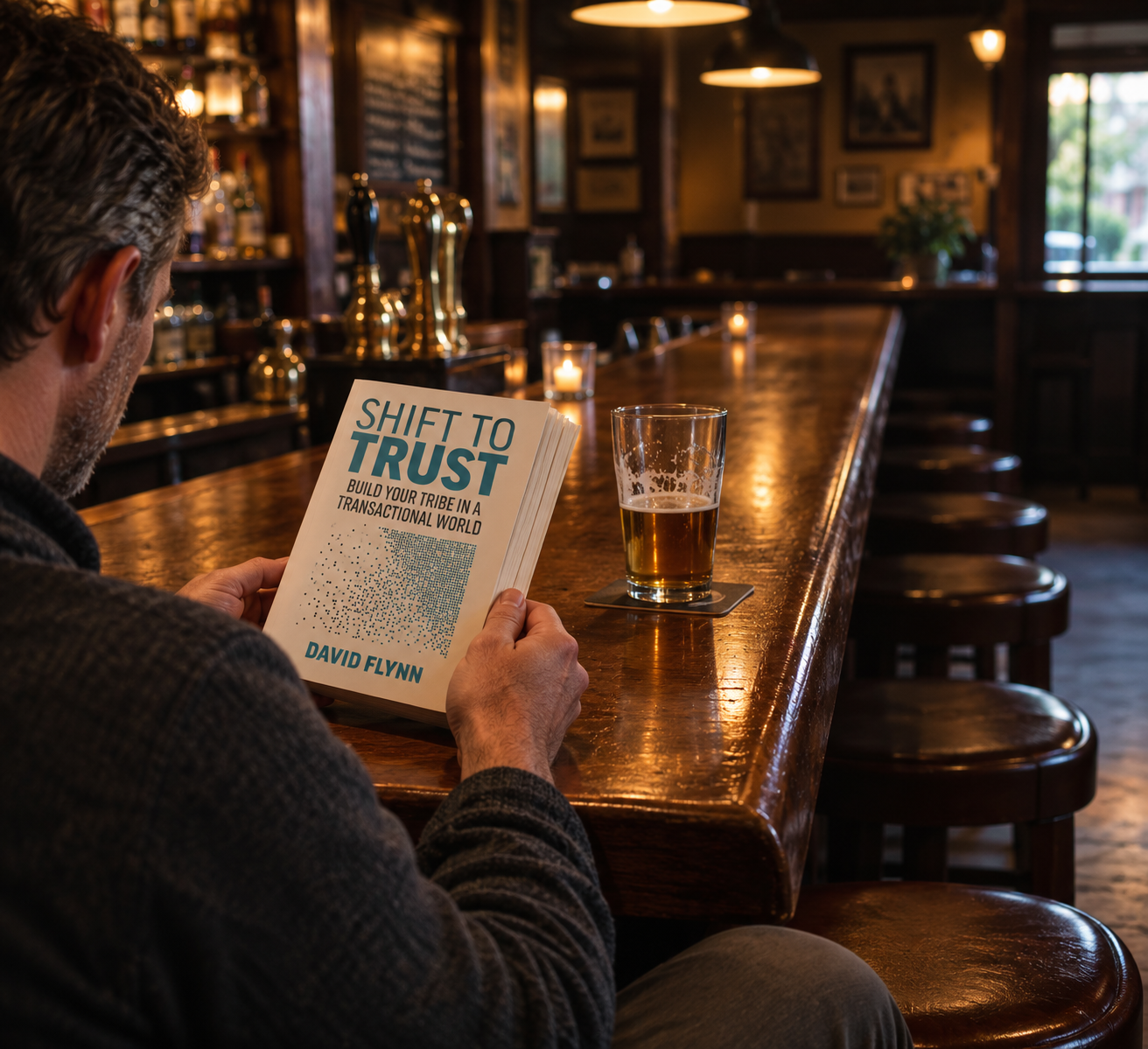
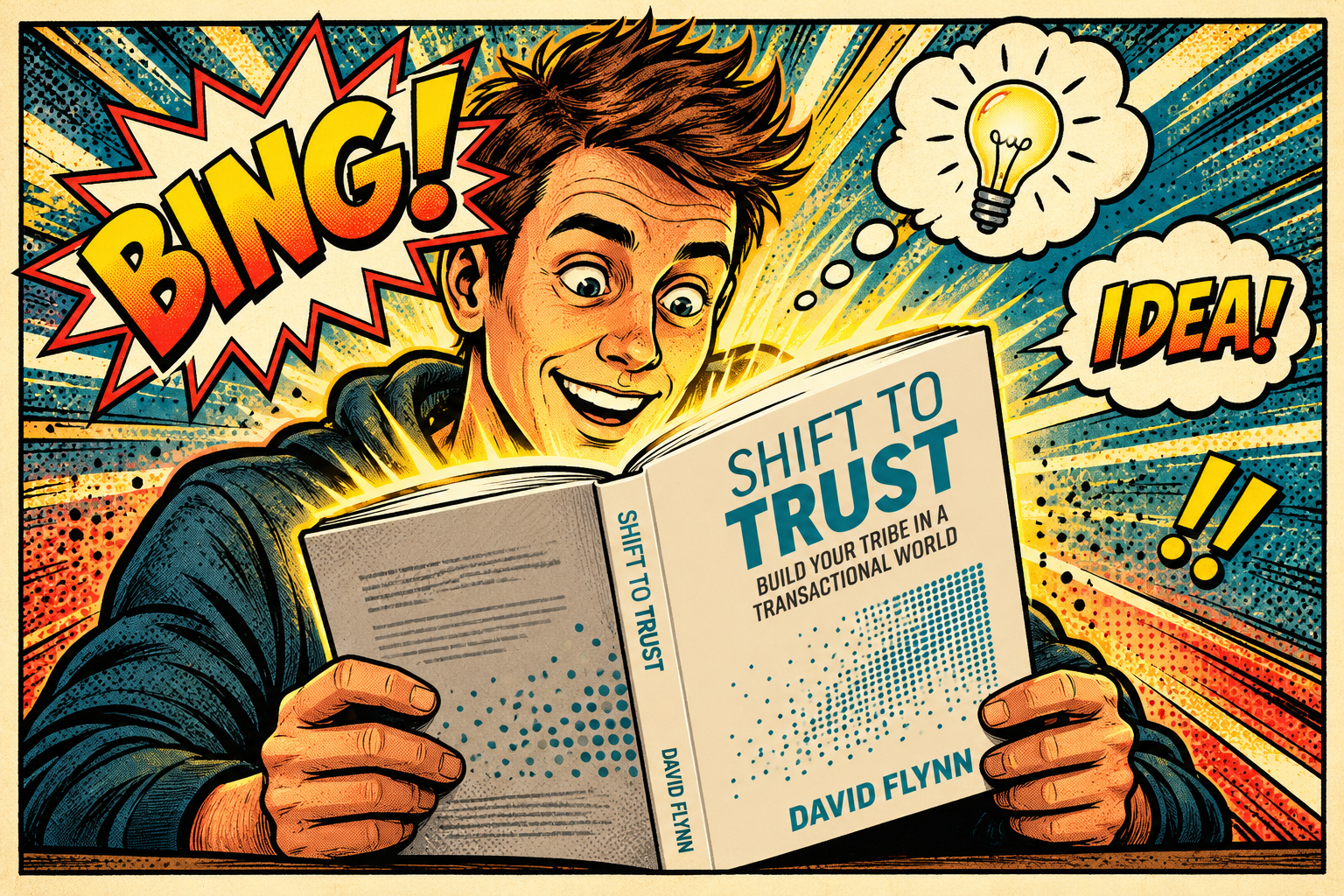
My latest book, Shift to TRUST, is available now. Want a copy?
Read: Amazon | Apple Books | Bookshop | Barnes & Noble
Listen: Audible | Spotify
I hope you find it both entertaining and educational.
And, to wet your whistle while Mr. Amazon prints and delivers your copy, below, courtesy of the Flynnternet, is the full introduction.
Introduction
A Convincing Lie—The Coin of the Realm—Cuddle Chemicals
“And why the hell should I trust you?”
Those were cutting words for a twenty-two-year-old to hear. After all, I’d just survived two whole weeks of on-the-job training at Wells Fargo Financial. I used all of it, every trick in the book, to coax this sergeant off-post and into my strip mall office in Lakewood Town Center.
We were suited and booted, it was summer, and we’d prop open the storage room door to catch the breeze. With it came the sizzling smells of Tijuana Taco, where I would be going for lunch—if only I could close a deal.

Outside the front door was your typical commercial sprawl, but my eyes were drawn to a building across the blacktop on a well-manicured stand-alone lot. That was Wells Fargo Bank, and if I showed some chops, some gusto, maybe I’d be able to transfer. Financial, where I was working, was the seedy underbelly of the financial industry. But we sure did turn a profit.
Have you ever walked into a discount furniture store, maybe the Mattress Depot or Mor Furniture for Less, and seen zero interest and zero payments, for twelve months? That was us. That was Financial. Buy now, pay later, before fintech took it over. But when the time came, if you missed a payment, we’d smack you down with 19.99 percent APR backdated to the loan’s origination. An iron hand in a velvet glove.
Be sure to read the fine print!
And that wasn’t even the worst of it. During those twelve months we’d call you day after day, “checking in” on your account. Questions? Concerns? I doubt it. As long as that chintzy Barcalounger arrived in one piece, we were no longer needed. But we called anyway, and after a few minutes of awkward small talk, we’d spring some unsolicited advice on you.
Yes, just a few months removed from my dearly departed college kegerator, I was kicking down financial advice to actual grown-ups, all under the banner of Henry Wells and William G. Fargo.
I’m sure they’d be proud.
“I can see here that you’ve got yourself ten grand in revolving debt.” I’d say as I refreshed their credit report without authorization. “That is quite a lot. Would you be interested in consolidating? It would give you just one bill to pay, less hassle, and it would save you some coin. Who doesn’t want to save a little money on their monthly payments, huh?”
I was, after all, a Credit Manager. They could trust a furniture financing Credit Manager, right?
My goal was just to make it through the day, but the company’s goal was to get our new trusting customers to bring as much of their debt as possible to Wells Fargo Financial. And collateralize it with the best possible asset, their home. A home that, in 2003, was increasing in value by the day.
Home not worth enough? No problem. We’d just let them “state” the value—no appraisal needed. Income not high enough? Same deal—no pay stubs, no proof, no questions asked. Still short? We’d lend 125 percent of what the place was worth. Why not? Prices only went one way back then. Up.
Seriously, you can trust me, I’m a credit manager.
When Sergeant Slaughter asked, “Why the hell should I trust you?” I nodded toward the sign and said, “This is Wells Fargo, ahem, Financial.” Looking back, the idea that you could blindly trust a bank was laughable. The question this warfighter was asking had very little to do with the names on the wall. It was personal. He was looking at me, my bad haircut, my cheap tie. Sizing me up.
I froze on the spot, fumbling and bumbling until Terry, my manager, stepped in. “I’ve been here at the bank for eighteen years,” Terry said, sliding into the conversation, “And I’ll be here for eighteen more.”
“Is that right?” The Sergeant said as he raised an eyebrow.
“That’s right. And Dave here is one of our best young credit managers.” A convincing lie.
“He looks like the intern,” The Sergeant replied with a smirk. They both chuckled. I blushed and, as I was taught, laid out the paperwork. An overwhelming pile of documents that included fee schedules, title reports, and prepayment penalties.
“You know what?” the Sergeant said with a knock-knock on my desk, “I think I’ll take those forms to go if you don’t mind.”
Terry attempted to continue the conversation, but our customer had already risen to his feet, starting his march toward the door. He’d leave our strip mall with that adjustable-rate second mortgage under his arm, unsigned.
Did I really think that loan was in his best interest? Or was I blindly following the corporate handbook?
A few months later, I was avoiding the phones when a wonderful couple from West Seattle walked through the door. I figured they were just there to pay off a loan, but they had other ideas.
They had their eye on a new RV from a local dealer. The gentleman was retired military, living off his pension, and his credit was shot. The RV dealership couldn’t help him.
I took his application, and shockingly, we couldn’t help him either. No matter how high the interest rate, even Wells Fargo Financial couldn’t approve the $280,000 loan. That’s bad.
I gave him the news and, disappointed, he thanked me for my time and walked out the door.
Two days later, he walked back in and took a seat.
“What about my house?”
“Your house?”
“Yeah, what about taking the equity out of my house and using that for the RV?”
He had been in the home for more than twenty years. He had $300,000 in equity. The market was hot and getting hotter.
My stomach sank. For a lot of credit managers, this was a dream scenario—someone walks in the door wanting an inadvisable home loan and will not take “no” for an answer. But I knew it was a bad idea.
I tried to talk them out of it. “You could be debt free in just a few years,” I said. I was giving my honest, transparent, and trustworthy opinion.
“It’s how we want to spend our retirement,” he replied.
If someone applies for a loan and they qualify, you can’t just decline them because it’s not what you’d do with your money. So as much as the deal made me sick, I had to process it. I had to take commissions on it. And that’s what I did.
It was the last deal I ever closed for Wells Fargo Financial, and it was the most educational.
Somewhere deep down, I think they knew that loan was a bad idea. I think they trusted me when I tried to talk them out of it. But the RV dealer was selling them something I couldn’t compete with. Not a vehicle, a life. He was selling membership. RV rallies, campgrounds, the open road, fellow travelers waiting to welcome them.
I saw financial risk. They saw their golden years.
They didn’t listen to me, but they did choose me. When they decided to tap their home equity, they had options. Why’d they come back? I think it was my candor, my transparency, even when it meant telling them what they didn’t want to hear.
But transparency alone wasn’t enough. I had more to learn.
The RV dealer was tapped into something real; I understood that. But I was just starting to see how I might do the same.
Terry and I wouldn’t stick around long enough to see them again. We’d leave Financial in the months that followed.
But the sergeant’s question left with me.
Why the hell should I trust you?
* * *
I moved to a new industry, Staffing, and then Consulting, and I heard that same question again and again. Directed toward me, and after a decade or so, directed toward my young teammates, “our best young account managers.” A convincing lie.
I chewed on the sergeant’s question for two decades. Did time build trust? Was tenure, being at the bank, the firm, the agency, proof of anything? What about those names on the wall?
While looking for answers, I stumbled across all sorts of advice.
“Trust is the glue that holds a team together.”
“Trust is the currency of leadership.”
“Trust is the coin of the realm.”
Stephen Covey uses the metaphor of an emotional bank account to describe the amount of trust that’s been built up in a relationship. But how do I make a deposit?
Brené Brown’s “marble jar” works the same way: small, repeated gestures that accrue goodwill. Remember a client’s birthday? Marble. Ask about their mom’s chemo? Marble. Every small act adds up, fills the jar, and builds trust.
It works, but mostly for lowercase trust—reliability and rapport.
UPPERCASE TRUST is different. It can’t be manufactured through small gestures or gamed with calculated kindness. It requires something deeper.
For years, my consulting firm operated under the marble jar methodology. We built our business on three pillars: operational excellence, relationships, and value-added services. All important parts of running a business, all could lead to trust, but they seemed to be just the beginning.
Unconvinced these small deposits would lead to lasting partnerships; I kept searching for answers.
* * *
Harvard’s Frances Frei and Anne Morriss have distilled their work into the Trust Triangle Trust, they say, rests on three dimensions: authenticity, logic, and empathy. Finally, something concrete:
People tend to trust you when they believe they are interacting with the real you (authenticity), when they have faith in your judgment and competence (logic), and when they feel that you care about them (empathy). When trust is lost, it can almost always be traced back to a breakdown in one of these three drivers.
Sounds simple enough, but we’ve seen it go wrong. Hustlers and hucksters count on it and manipulate the formula. They’ll smile, nod, and check those three boxes. All the while, they’ve got an angle, some spin. They want something. Can you spot them? Will they trip the authenticity alarms?
If it sounds too good to be true, it probably is. That’s why the Trust Triangle requires all three elements. But all three can be faked—and often are.
Bernie Madoff seemed “authentic”—the humble kid from Queens who saved his initial stake from lifeguarding, delivered steady returns without fanfare for decades. He came across as “empathetic,” funding hospitals and universities and making investors feel heard. The numbers were boring by design, 12-13 percent a year. Steady, predictable, “logical.” On Wall Street, some even joked that he was the “Jewish T-Bill.” On paper, there was nothing to question.
He checked every box on the Trust Triangle. And he stole $65 billion.
The Trust Triangle identifies what needs to be present, but not how to verify it. That’s where the real work begins.
We’ve all fallen for someone or something that we shouldn’t have. A girl, a car, a job. In hindsight, we see our mistake, but at the time, we were blinded.
How can you tell when someone is full of shit?
Sometimes, you can’t—not in the moment. But you can stack the odds in your favor.
* * *
Why do we keep trusting? Why not just stay guarded?
Because it feels so damn good to trust.
The biological mechanism at play, oxytocin—sometimes called the “cuddle chemical” or “bonding hormone”—is a neurochemical produced in our brains that promotes social bonding, empathy, and trust. Originally discovered for its role in childbirth and maternal bonding, scientists now know that oxytocin orchestrates much of our social behavior.
Neuroscientist Paul Zak found that oxytocin lies at the heart of trust. When someone shows trust in us, our brains synthesize oxytocin, which makes us more empathic and cooperative—and more likely to trust them. This creates a positive feedback loop: “trust begets trust” in a virtuous cycle that strengthens relationships. As Zak’s research demonstrates, “The more trust one is shown, the more the brain produces oxytocin.” Think of it as the biological basis for the Golden Rule—when treated well, our brains chemically motivate us to respond in kind.
Zak wanted to know if oxytocin really did cause trust. So he gave students a nasal spray—oxytocin or placebo—then had them play “The Trust Game.” Students were asked to invest money with a stranger. When they did, their investment tripled. But the stranger had options. They could return the student’s initial investment, share some of the earnings, or keep it all to themselves. Did investors trust that the stranger would pay them back? Share their earnings? Those receiving oxytocin were more than twice as likely to invest the maximum amount of money.
Google wanted to know if trust worked the same way inside groups. Project Aristotle studied 180 teams and found that the single best predictor of high performance was psychological safety—the trust that you can take risks without being punished.vii More than talent and strategy, trust.
Trust is social, psychological, and biological. It’s hardwired into our neurology.
It’s evolution, baby!
* * *
Unfortunately, our biological craving also makes us vulnerable.
Robert Cialdini’s work on influence reveals the tactics: reciprocity, scarcity, authority. These get you compliance, not trust.
And we use them unconsciously:
“I did the dishes. You can take the trash out.”
“Well, I’d be more than happy to do the dishes if you didn’t go full scorched earth in the kitchen. Look at this place!”
“Excuse me? I was making dinner for our family while you were playing golf.”
“You’re the one that wanted to join the country club in the first place.”
“I joined for the gym…which obviously, you never use.”
And so, it goes.
This couple isn’t solving anything. They’re keeping score. Negotiating every minute aspect of their lives together.
All that mental accounting is exhausting. It sticks in our craw like some Tijuana Taco.
It’s trust-lite®—a shortcut that creates the appearance of trust. It might buy you a night of peace, but it’s a Band-Aid on a bullet wound. From a distance, it looks like the real thing. And that’s what makes it dangerous.
When someone asks, “Why the hell should I trust you?” I no longer point to a sign on the wall.
For two decades I tested approaches. Made mistakes. Looked for what separated the partnerships that lasted from the ones that didn’t.
What I found was a framework hiding in plain sight. Five shifts that move you from transactions to tribes.

Charlie Munger said it best: “The highest form that civilization can reach is a seamless web of deserved trust.”
These shifts will show you how to build it.
What do you think?
That’s the introduction to Shift to TRUST. The rest of the book explores trust through stories from business, history, psychology, and pop culture.
If you’re curious, the book is available now in print, digital, and audio.
Read: Amazon | Apple Books | Bookshop | Barnes & Noble
Listen: Audible | Spotify
And because ideas are more useful when you put them to work, I’ve created a free Trust Toolkit to help you apply the five shifts.
There’s even a playlist of the music mentioned throughout the book.
I appreciate you being a reader here at WinWithFlynn.com. If you enjoy the book, please tell a friend, leave a review, or send a few of those stars my way.
Every little bit helps.
If you enjoyed this post, please share it with a friend.





What do you think?