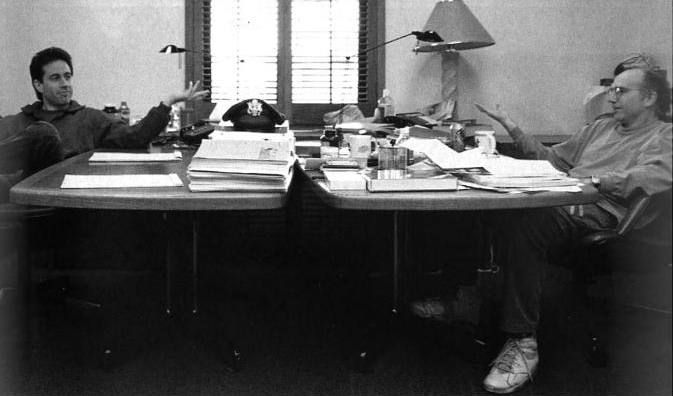
The 2017 HBR interview with Jerry Seinfeld has had a resurgence over the past few months as a new batch of entrepreneurs and MBAs come to terms with something profound.
Jerry Seinfeld might be the best management consultant you never hired.

Of course, now you can’t afford him, but for years Jerry provided a weekly dose of insights on all manner of topics from family life to dating to business, cutting through the BS, and giving viewers a new way to see themselves in the world.
Shrinkage.
Double dipper.
Re-gifter.
Big salad.
These terms are shorthand for real world scenarios.
The Harvard Business Review interview takes just 2 minutes to read, but it frames Jerry’s view on a number of topics, including creativity, management, and innovation.
“You and Larry David wrote Seinfeld together, without a traditional writers’ room, and burnout was one reason you stopped. Was there a more sustainable way to do it? Could McKinsey or someone have helped you find a better model?
Who’s McKinsey?
It’s a consulting firm.
Are they funny?
No.
Then I don’t need them. If you’re efficient, you’re doing it the wrong way. The right way is the hard way. The show was successful because I micromanaged it—every word, every line, every take, every edit, every casting. That’s my way of life.”
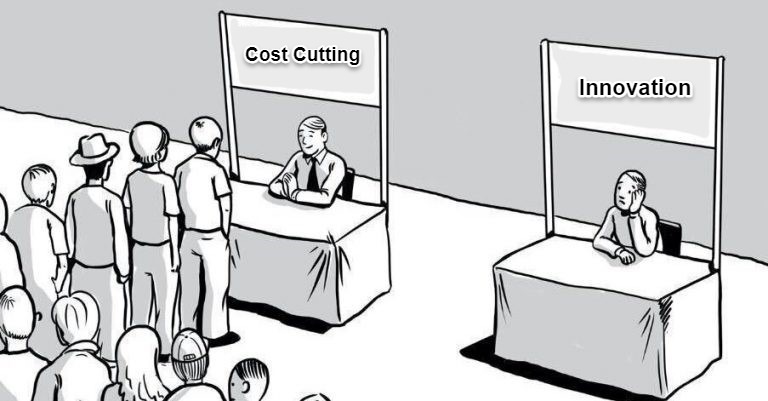
“Are they funny?” is the quote that gets laughs while most are missing the point. It’s not a shot at McKinsey, it’s a shot at all of us, and our inability to focus on what matters.
It’s shorthand for “the main thing is to keep the main thing the main thing.”
To steal even more liberally from Stephen Covey and his book First Things First, it’s a focus on the compass not the clock.

No doubt Mckinsey has funny people, and your firm does too, but that’s not the point.
The point is, when funny is your singular goal, you either bring in people for funny, or you bring in people to make you a sandwich.
What you don’t do is bring in someone for funny, and instead they focus on making funny faster.
Funny takes time. It’s like a crock of kimchee. You can’t rush it.
Jerry left the autonomous world of stand-up comedy for the big business of network television, and with that came partnership and outside perspectives.
“Now, in the TV network world of those days when the network executives say, “we have an idea to make your show better,” it is always, without fail, without exception, the worst idea you have ever heard, which is not their fault. It’s not their job to have funny ideas. It would be like if a geologist sent me out into the desert to find the mineral bauxite. I could never find it. I don’t know what bauxite is — I’m not a geologist. Even if I found it, I would not know that I had found it. I can’t tell one rock from another. This is why most TV sitcoms are not funny — bauxite: if you’re not a geologist, don’t go looking for it.”
Jerry Seinfeld, Jerry Seinfeld on Julia Louis-Dreyfus & “Seinfeld” | 2018 Mark Twain Prize
Can punching up the script work? Can “network notes” add value? Sure, and Jerry even said so. Julia Louis-Dreyfus was a “network note,” but more often than not the person coming in with notes, the consultant, they don’t have the same vision of the future, so the notes fall flat.
They want to synchronize watches not calibrate the compass.

Different goals, different north star, different main thing.
It’s why those epic collaborations are so special.
Steve Jobs and Steve Wozniak.
Jerry Seinfeld and Larry David.
Paul McCartney and John Lennon.
When Jerry asks if Mckinsey is Funny, it’s a quick and dirty way of asking if they are additive. Can they contribute to what we are doing or are they just a distraction?
This is a common business issue. What areas should a company use consultants, what areas do they outsource all together?
And the best answer I’ve heard is from Tony Hsieh, founder of Zappos.
In his book Delivering Happiness, Tony discussed the growth of Zappos and the need to expand their warehouses. Tony said “it was a valuable lesson” bringing in eLogistics to run that part of the business, because it failed so spectacularly. Zappos quickly reversed course and took control of the operation. Tony learned they “should never outsource our core competency. As an e-commerce company, we should have considered warehousing to be our core competency from the beginning.”
Business is dynamic. You don’t always know what the future holds.
Microsoft had a thousand consultants handling operations in their global data centers, and eventually they came to the same conclusion as Zappos. They decided to bring the work in house, converting hundreds of consultants to Microsoft employees.
Why the change of heart?
Azure. The cloud.
Their datacenters went from a cost, an expense, to their biggest driver of growth. They changed strategy and the datacenter was now going to be a core competency.
Companies and industries will differ on this, some game studios can’t wait to outsource operations once a game is published. Why? They are creators, that is their core competency, the story and the art. They’ll leave LiveOps, Moderation, and Player Support to someone else.
Jeff Bezos, urging companies to move their infrastructure to AWS, said “producing your own electricity doesn’t make your beer taste better.” Breweries in the pre-electric grid era of the late 1800’s had to generate their own power. They could have kept that power generation in house but none of them did. Once the electric grid was in place, the breweries refocused on the main thing. They refocused on the beer.
You’ll need to do the same thing. Outsource the electricity. Focus.

It’s a heavy subject, and Jerry cuts right through it, but knowing your main thing takes self-reflection and vigilance.
If the main thing is family time, gas milage doesn’t matter so much. Neither does the fastest route. But we’ve all been around Dad trying to set a land speed record on the family road trip.

Starbucks found themselves off trail several times. They thought Hear Music was the main thing. They thought CPG was the main thing. Juice too. Eventually they found their way back to coffee.
See how easily we get it twisted? Lose focus? It’s not always going to be easy.
“If you have more than 3 priorities then you don’t have any.”
Jim Collins
Jerry knows the main thing. The script, the lines, the bits, the jokes. The funny. And he knows he can’t outsource that, especially to someone who doesn’t get it.
Craft services, sure. The cast and crew, maybe. Set design, I guess. But his part, the core, the funny stuff on a show with just one goal, to be funny, that’s a hard pass.
That’s the quick and dirty lesson. You could pay a management consultant to analyze it, but Jerry gave you this one for free.
You don’t outsource your core competencies. The main thing is to keep the main thing the main thing. And the easy way to remember that is with one simple question.
Are they funny?
If you enjoyed this post, please share it with a friend.