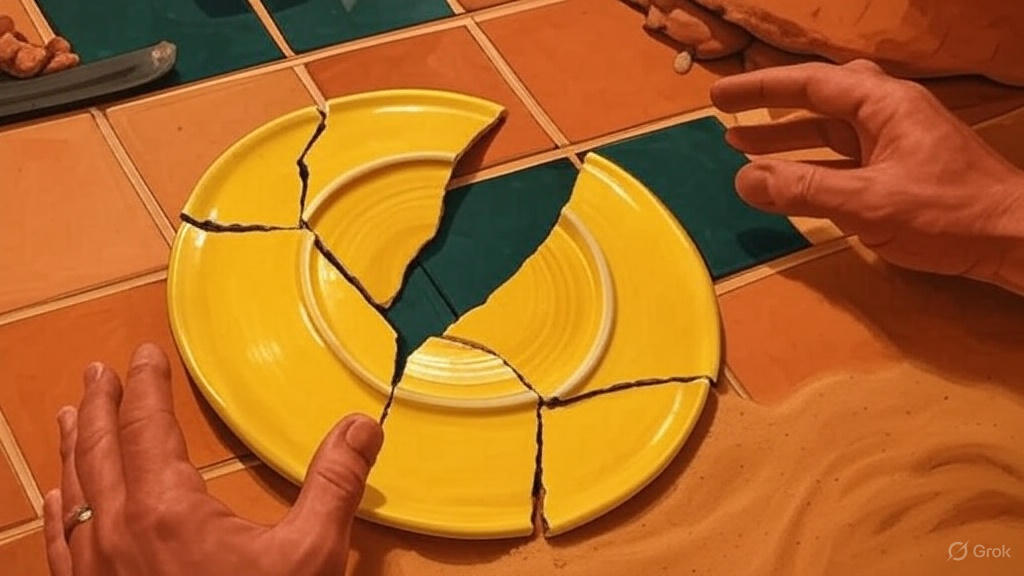
An important aspect in completing a puzzle is keeping the box top handy.
Without it, that jigsaw puzzle full of cute kittens might drive you mad. Where does the Siamese go? Or the Tabby?

The box top provides all the directions you need, it shows you a vision of what you’ll be building.
My family puts together a fun puzzle during the holidays every year. It’s the leg lamp. The one from A Christmas Story.

Someone’s Uncle gave it to us a few years back and on the first go around I dumped the pieces on the table and discarded the box. Didn’t even think about it. But the kids had no clue what we were building.
“A leg lamp? What the hell is a leg lamp, Dad?”
Puzzle Box Tops Provide The Vision:
It’s a common mistake, forgetting that we don’t all come from the same background. The team might be nodding their collective heads, all the while they are wondering, “what is it that this guy wants us to build?”
You can’t assume that everyone understands the vision. Sure, the kids had all the materials required to build the leg lamp, but materials are not enough.
A problem solver is a blessing on any team, and if you have one, they will jump right in. They’ll want to chase down answers because they like a good challenge. They want to make it work. And depending on their background and the project complexity, they might make it happen.
Will it look exactly as you imagined? Probably not, but that’s okay. You’ve got to let them paint.
But if you want everyone headed in the same direction, at the very least, provide the box top. Something that helps the team see what they are working towards.

Show them the whole picture.
What is the vision?
Silos Will Create Their Own Vision:
If everyone is heads down on their little part of the puzzle, the team will get confused.
“Suppose you have a jigsaw puzzle, and you put just three pieces together and make a picture.” Sadhguru describes a common scenario, “Well, that’s great for you. It feels good. But it’s not the whole picture.”
And that can happen.
Luke had some idea of who he was back on Tatooine. He thought there was more out there for him, but had no clue that his world included Darth, Obi-Wan, The Force, and all that he would learn in the coming months and years.

Luke only had his few pieces of the puzzle. His Aunt and Uncle, and their farm.
And yes, we are still talking about puzzles.
I’ve worked on puzzles like this as well.
We each have a piece. Our unique contribution. We fit those pieces together, sometimes easily, sometime with a bit of muscle. Now we have a team, a little picture, and it feels good to build, create, and contribute with them.
But if you asked me about other parts of the puzzle, I didn’t have a clue.
In addition to not providing the box top to share a vision, leaders make another common mistake.
Leaders hire managers.
When Managers Manage:
Managers see the world differently than most. They’ll take that grand vision and try to systematize it.
How fast can you snap puzzle pieces together? How cheap, how efficiently? Maybe we can do it offshore or nearshore. Maybe robots and process automation can help.
They end up managing through proxy, and the big picture is missing. There is more to the leg lamp than the speed at which you can snap together pieces.
There is more to the universe than shooting womp rats from your T-16, Luke.
Again, just talking puzzles, folks.
When managers manage, teams get siloed, jobs get broken into skills, and people lose track of how they fit into the larger picture. What are we building around here? Am I a corner piece? Am I an edge? What is my contribution?
When managers manage, or heaven forbid when they consult, those processes really start getting defined. Breaking each role down into its parts and turning every part of the business into an assembly line.
“What would you say you do here?”
When managers manage, they look at all these different puzzle pieces and they get frustrated with their nuance. After trying to slam a few unrelated pieces together they have a brilliant idea.
Let’s get rid of all these curved pieces, they are slowing down our puzzle building!

They’ll get rid of all the uneven edges. Those damn pieces are too hard to fit together. Instead, they bring in a bunch of uniform, undifferentiated, squares. They call it culture fit.
And at first it seems to work. With squares, all the edges fit against all the edges. Uniform. Easy.

The manager will feel pretty good about the progress. Might even bring in some Jimmy John’s for the whole team on Friday. That will bring folks together.
But the picture doesn’t come out so hot.
Interchangeable pieces seem like a good idea, until you do the interchanging part. People don’t really work that way. Can’t put the Tabby body on the Siamese head.
When you get the pieces confused, you might accidentally think Lando Calrissian is your hero.

Lando is a helpful cog, but he is not your hero. Managers relying on proxy and implementing systems will lose the ability to see that. The pieces are squared off and it’s hard to see who should be at the center of things.
People have unique skills and abilities. Different cuts, sizes, and shapes.
A puzzle is made up of unique and interrelated pieces. Interrelated, not interchangable.
The pieces fit together in a particular way. It takes time for them to find their place, but the picture comes out a helluva lot better.
Puzzles, we’re just talking about puzzles.
Each piece has value and significance. Interchangeable parts lose that.

Provide The Puzzle Box Top, Provide A Vision:
The point is this. Instead of spending all your time optimizing and systematizing, try providing the top of the puzzle box. Try providing a vision. A vision built from unique parts, fitting together to make a larger picture.
Because smoothing down the edges and cutting out all the uniqueness sounds like the recipe for making Storm Troopers.
And we’re here to save the galaxy.