Listen to this post: Apple Podcasts | Spotify | YouTube
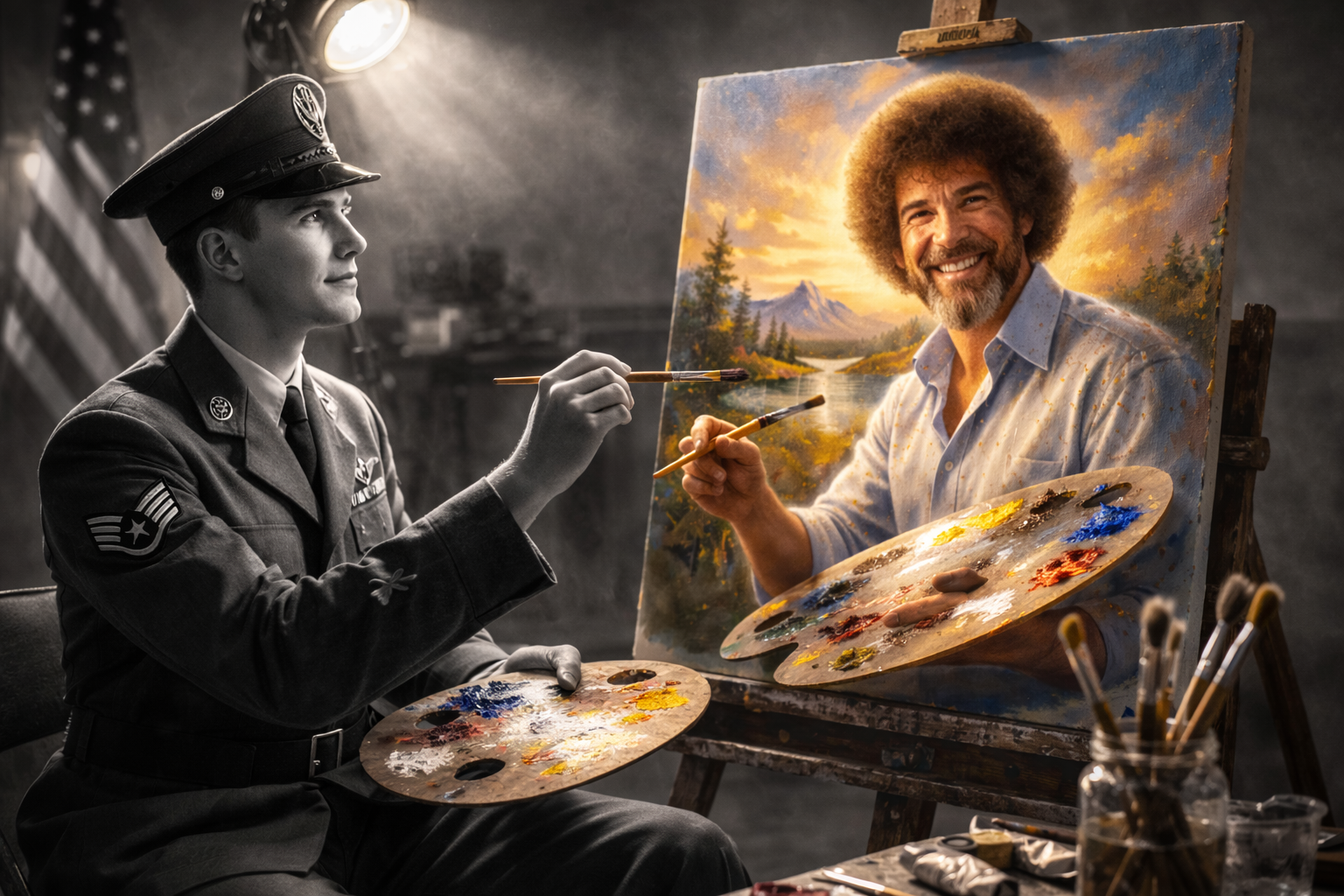
For twenty years, Robert Ross made you scrub the latrine.
Master Sergeant. First Sergeant. The guy who screams at you for being late, who inspects the corners of your bed, who demands perfection. That was his job at Eielson Air Force Base in Alaska.
And he was damn good too.
But he hated it.
“The job requires you to be a mean, tough person,” he said. “And I was fed up with it. I promised myself that if I ever got away, it wasn’t going to be that way anymore.”
He did get away. He’d actually been sneaking off for years. Using lunch breaks to paint Alaskan landscapes on gold-panning tins, selling them to tourists, making more money from painting than from the military. Becoming someone totally different.
You’ve probably seen him. The perm. The soft voice. A PBS show that ran for eleven years with reruns for decades after.
Drawn in by that soothing “tap-tap-tap” of the brush, palette knife scraping mountains out of the clear blue sky. The show puts you in a trance.
But it will also have you scratching your head.
After ten minutes, the painting is taking shape, and a novice might stop there. But Robert Ross pushes on. He adds layers. Texture. A bush here. Some friends there.
If you’re watching for the first time, you might panic with each addition. What in the hell is he doing? He’s ruining it!
And that’s pretty damn accurate, it would be ruined, if he stopped. But he’s not done and it’s not ruined. Actually, it’s a touch closer to being great.
He understood, probably better than anyone, the voice that makes you panic—he’s ruining it, fix it, stop—that voice is the enemy.
In The Inner Game of Tennis, Timothy Gallwey calls it Self 1. The conscious critic. The instructor in your head who says bend your knees, racket back, step into it, no not like that, what are you doing? Self 2 is instinct—the part that already knows how to move, how to adjust, how to learn. Through doing.
Self 1 is Master Sergeant Robert Ross. A real hard SOB.
Self 2 is Bob Ross. Americas favorite painting teacher.

“On this canvas, you can do anything. Anything your heart desires.”
He wasn’t just talking about painting.
Bob’s whole method—wet-on-wet painting, alla prima, finishing a canvas in 28 minutes—was an attack on Self 1, the enemy. Traditional oil painting forces you to stop. To wait for layers to dry. And in that waiting, the doubt creeps in. Is this right? Should I fix that? What will people think? I’m no artist!
Wet-on-wet removes the waiting. Removes the ruminating. Removes the judging. You keep moving. Momentum builds stability. You attack the canvas, and you don’t let up until it’s complete.
Give resistance and self-doubt an inch and they will take a mile.
Bob kept the brush moving so Self 1 couldn’t get a word in.
“We don’t make mistakes,” he said. “We just have happy accidents.”
He built this gentleness deliberately. He swung the pendulum to the opposite of everything he’d been in the military. He knew exactly how loud Self 1 could get, because he’d been Self 1 for two decades.
He designed a method to starve that voice of oxygen.
I coach my son’s teams. And I’m guilty of being Robert Ross from time to time.
Not the screaming—I’m not a drill sergeant. But the correcting. Coaching every rep. Elbow up. Follow through. Square your shoulders. Like they have joysticks on their heads.
Larry Bird’s parents were tough on him, but they never subjected him to slow-motion replays of his jumper at ten years old.
I was working with the team last week, talking about the BEEF method for shooting, and somewhere in the middle of it I thought: these kids will figure out how to get the ball in the hoop if I just let them play.
But I can’t help myself.
Swings off the tee, math homework, turkey sandwiches. I’ve got methods for all of them. And I feel compelled to blabber them all over the place.
Why?
When my kid misses a shot, I feel it. I know I shouldn’t, but I do.
It feels like a reflection. Of my coaching, my parenting, my friggin’ DNA.
So I correct. I instruct. I tinker. I want him to have something that’s his. Anything really. A thing he excels at. Is passionate about. So I clear a path. But every correction makes it a little more mine and a little less his.
I know the kids play best when they’re loose. Not thinking, just feeling.
And then I turn the whole sport into painting by numbers. I want to see something that resembles the picture I have in my mind, rather than letting them interpret the ideas in their own way.
Don’t mistake activity for achievement.
I try to quiet my own Self 1, telling me that my child’s performance—or my team’s performance—is a reflection of me.
See, I did it again. My team?
It’s a reflection of them. Their body, their timing, their joy. I forget that it’s their game to win or lose. I forget there are ways to win that have nothing to do with the scoreboard—being the most excited to play, having the most fun, being the best teammate.
I forget, because my Self 1 is so convincing. It wants to be everyone else’s Self 1 as well.
Their bodies are changing. Their neural pathways are forming. They are, quite literally, works in progress. Wet-on-wet.
So on my good days, I try to coach intent. To coach and parent their Self 2. Not mechanics and scenarios, but feel.
A high arching shot in basketball—one that lands soft, has a descending angle, improves the odds of going through the hoop.
How you do it? That’s on you.
A line drive up the middle in baseball—hit it hard, somewhere, in the air. That’s the desired outcome. Self 2, with proper time and space, will figure out the rest.
I’ve coached kids who left for spring break and came back a foot taller. They lost all control over their limbs. Baby giraffes on roller skates. The step-by-step procedure they’d been using doesn’t work anymore. Nothing feels right.
The temptation is to load them with the latest instructions. Diagnose the problem. How’s the grip? Elbow up! Follow through!
But that just makes Self 1 louder.
The better version looks like this. The same kid, the same spring break, just hanging at the lake, and between cannonballs he’s playing catch with his cousin. Not thinking about anything. Just trying to hit the glove. That kid’s body is learning to feel. Something clicks. Some neural pathway connects. Self 2 figures it out while Self 1 is on vacation.

Bob Ross retired from the Air Force in 1981. For twenty years, his day job had been yelling at people. Demanding procedures be followed. He was still finding his way—teaching painting classes at malls and Holiday Inns. The TV show didn’t start until 1983. He was 40.
Forty.
“Talent is a pursued interest,” he said. “Anything that you’re willing to practice, you can do.”
The critics who said he was doing it wrong—the traditional painters who called his work mass-produced kitsch—whose lives did they touch? Who did they inspire?
Bob wasn’t trying to create museum paintings. He was trying to get people to pick up the brush.
Am I coaching the next Bryce Harper? I have no way of knowing. But the goal is much easier to define and achieve: to get kids to pick up a ball.
And then, to give them just the slightest push. To urge them to go a little further.
There’s a test at the end of every episode of The Joy of Painting. With about two minutes left, Bob would take his beautiful landscape and slash right down through it, adding a big tree in the foreground. His producer, even after years of working together, would be terrified. Bob called it a bravery test.
What in the hell is he doing? He’s ruining it!
If you’re brave, the tree gives depth. Perspective. The painting goes from flat to alive.
Sure, you could skip the tree. The painting would be fine without it. Pleasant, even. Hang it on the wall, get some compliments. But there’s a ceiling on “fine.” If you want to reach the next level, you have to risk ruining the whole damn thing.
My son’s basketball team ran ball handling drills every practice this season. Every time, the ask was the same: keep your eyes up. Go slow if you need to. Walk if you have to. But keep your head up.
They didn’t do it. All season, they raced. Eyes down, chasing the ball, trying to be first.
A few weeks ago, something shifted. Kids were walking. Eyes up—some of them exaggerating it, staring at the ceiling, fighting the urge to look down. I asked my son what happened. The whole team, all at once?
“It’s not a race,” he said. “It’s like we made up this race that wasn’t real.”
I asked what changed.
“I guess we all just got sick of the other team taking the ball from us.”
They figured out that the fast way wasn’t the good way. They had to break themselves down a little to build back up.
That is the bravery test.
And you can’t pass it if Master Sergeant Robert Ross is running the show. That guy says don’t risk it, you’ll look stupid, what will people think.
The bravery test requires Bob Ross. The guy that keeps the brush moving.
If we give kids space to bravely slash right down through whatever it is they are working on, they’ll make a habit of it. The career that’s comfortable but capped. The relationship that’s fine but could be great. The creative work that’s good enough but not yet what it could be. Every meaningful leap requires a moment where you look at the nice little painting you’ve made and decide, even with just two minutes left, you are going to add a big fat tree right in the middle of it.
Most people won’t do it.
But the ones who learn early—that temporary destruction is the price of growth—carry that lesson everywhere.
Master Sergeant Robert Ross spent twenty years screaming, correcting, demanding perfection.
Then he killed that voice. Starved it. Built a method designed to keep it quiet—28 minutes, no stopping, no waiting, no time to judge.
I haven’t killed mine yet. I know he’s there. I can hear him in the corrections, the methods, the compulsion to coach every rep. And I’m working on it.
Bob Ross didn’t nail it until 40. But he was becoming the whole time.
I think, I hope, I am too.
Keep the brush moving. The kids playing. It’s a process.
“If you don’t like it—change it. It’s your world.”
If you enjoyed this post, please share it with a friend.







What do you think?