Listen to this post: Apple Podcasts | Spotify | YouTube
Imagine yourself in a wrestling match.
You try a move—it fails. You try another. Still no luck. Your heart starts racing. You attempt a risky maneuver, leave yourself exposed… 1-2-3, pinned.
As you hustle off the mat toward your coach, he shakes his head.
“You had it,” he says. “You had it the whole time.”
But with your head buried in your opponent’s ribcage, it was impossible to see.
That’s wrestling. That’s business. That’s politics. That’s life.
Detaching when the stakes are high—taking a breath, stepping back, seeing the field—is one of the most important skills a person can develop. Because it leads to better decisions. And better decisions, compounded over time, are about as close to a superpower as we can get.
The question is: how the hell do we do it?
First Person
When first-person perspective arrived in video games, it felt revolutionary. Suddenly, instead of controlling the character, you were the character. You saw what they saw. You felt the speed, the danger, the immersion.
It was electric. First-person felt like the future.

But as games became more complex, more competitive, more tactical—players realized that total immersion came at a cost. You couldn’t see what was closing in from behind. You couldn’t read the environment. You were in it, but not unlike the wrestling match, being too close can leave you vulnerable.
So developers—and players—stepped the camera back.
With a click, you’d rise above and behind your character. Third person, over the shoulder. Back far enough to see your direction, and high enough to see the environment. But close enough to stay in the moment.

Still, it was incomplete. No problem. Pull back further. Go full third person, slide into the map view. Now you can see your position relative to every competitor, every obstacle, every opportunity.

Immersion keeps you in the game. Awareness shows you the field. Strategy requires both.
We play out our lives in first-person mode. But in most pursuits—business, relationships, leadership, health—zooming out, getting to third person, or taking an occasional look at the map is how you avoid getting lost, blindsided, or worse.
It’s why coaches and mentors exist.
The Eye in the Sky
A smart coach and a capable quarterback can get a lot done from the field. The quarterback is playing first person—the snap, the pocket, the read, the throw, all happening in seconds. His coach on the sideline has a slightly wider view, plus a few decades of pattern recognition. That combination works.

But in 1934, someone had a better idea.
During the NFL Championship at the Polo Grounds, Columbia University coach Lou Little—moonlighting as a Giants assistant—climbed high into the stands and got on the phone with the bench below. From up there, he could see defensive alignments no one on the sideline could. The Giants mounted a comeback and won 30-13.
It was a clever hack. But it took Paul Brown to turn it into a system.
Brown is widely considered the father of modern football. He was the first coach to use game film to scout opponents, the first to hire a full-time staff of assistants, the first to call plays from the sideline, and—critically—the first to place an assistant coach in the press box to relay information during the game. He built a game film library. He tested players on their knowledge of the playbook.
The results were staggering. Brown’s Cleveland Browns won seven league championships. His coaching tree produced Bill Walsh, Don Shula, Chuck Noll, and Weeb Ewbank—four Hall of Famers who won a combined ten Super Bowls. Bill Belichick called him “the father of professional football.”
Today the practice goes even further.
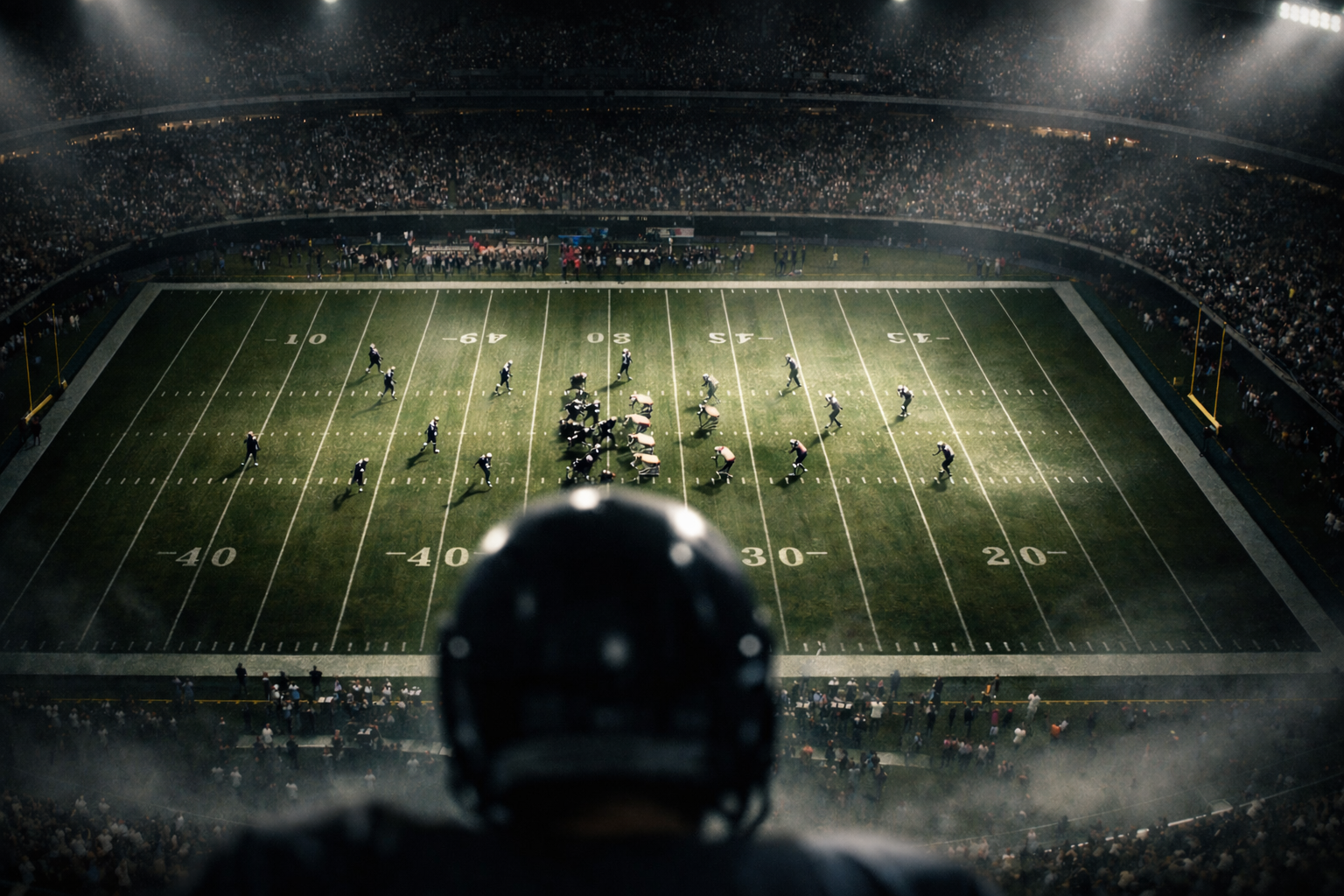
When teams review game film, they watch something called the All-22. It’s a camera view from high above the stadium that captures every player on the field—all 22 of them—simultaneously. It’s a view no quarterback or coach ever gets in the moment.
And it is humbling.

Anyone who has watched Hard Knocks knows what the All-22 does to a room. Plays that felt brilliant in the moment look reckless. Reads that seemed obvious turn out to be lucky. The film doesn’t care about your intentions or your feelings. It just shows you what happened.
It is both painful and clarifying, in equal measure.
What if we had that for our own lives? What would the All-22 of your last difficult conversation reveal? Your last big business decision? That Thanksgiving dinner that went sideways?
I’ve got a few convos I’d like to run back. How about you?
The Sideline Effect
Here’s something coaches and athletes have known for a long time: sometimes the best thing that can happen to a player is planting their rear end on the bench for a while.
A benching. An injury. A forced pause they didn’t ask for.
It sounds like punishment. And in the moment, it feels like it. But many players look back on those periods as turning points.
Kurt Warner spent most of his college career at Northern Iowa buried on the depth chart. After finally starting as a senior, he went undrafted, got cut by the Packers, and spent the next few years stocking shelves at a grocery store and playing in the Arena Football League. When he finally landed with the St. Louis Rams, he spent another season on the bench. But he watched. He observed.
In interviews he has said, “I learned more about the game sitting on the sidelines than I ever did playing. I could see the field, read defenses, understand what good decisions looked like. When my time came, I wasn’t just ready physically—I was ready mentally.”

He went on to win two NFL MVP awards and a Super Bowl. His rise required talent, but perspective, earned the hard way, is what got him to the top.
Even after winning a ring, Warner’s career sent him through more benchings—losing the starting job to Eli Manning in New York, battling for playing time in Arizona. Most veterans would have checked out. Holding a clipboard is a pretty nice way to earn a living. Warner kept the headset on. He used his time as a backup to study defensive schemes, and when he finally got the start for the Cardinals, he could see the field like never before.
The old joke holds: Do you know what they call a quarterback who doesn’t watch film?
The Bias in the Bleachers
There’s a catch to all of this, and it’s worth naming before we go further.
Head down, defenders closing in, three seconds to make a decision. You can’t see the field because you’re too deep inside the moment. That’s a visibility problem. The solution is to zoom out—coaches, film, mentors, the map view. Get the camera in the upper deck.
But there is another path to failure that is more common than you’d think.
Watch a close call go against the home team sometime. The eye in the sky is right there on the screen. Every angle confirms the call. The player was clearly out of bounds. And fans are still screaming, still booing, absolutely convinced he was in.
You can ask them directly, and I have, “You see that he was out, right?”

They can’t see it. Not through the makeup and wigs. Their emotional investment has made them choose a fictional version of the play. They have full access to the perspective we’ve been advocating for—and they’re actively rejecting it in favor of what they want to be true.
This is not stupidity. It is human nature. And it lives in all of us, in the areas where we have the most invested.
It’s also why you can’t outsource your perspective. Fans, critics, they are all around us. Some of them even have nice hair, and work on TV.
Fans will tell you you’re brilliant, critics will tell you you’re wrong, and it’s unclear if either is watching the film. If they are, neither is watching honestly. The goal is to develop systems that will give you an honest analysis from someone in the trenches of your life. You.
Which means getting the camera is only step one. Step two is watching the footage without flinching. And step two is much harder.
The higher the stakes, the more deliberately you have to build honest review into your process. It won’t show up naturally. Your brain will protect you from uncomfortable truths every chance it gets. The system has to be stronger than the instinct to look away.

Developing Your Own All-22
First: are you sure you want to? I’m writing this, and I’m still not entirely sure I want to. The All-22 means no hiding. It means, you see the truth.
And it takes practice. But the practice maps cleanly onto the same three perspectives we talked about at the start.
Level One: First Person—Capture It
You live in first person, so you are probably aware of the issue at hand. Recalling what you had for lunch is hard enough—reconstructing the details of a given day with any real clarity is nearly impossible.
Level one is to capture—to record your thinking and perspective before your memory starts rewriting events into something more (or less) flattering.
Journal. Keep a decision log. Record a voice memo after a hard conversation. Write a quick note before a significant choice. The format doesn’t matter much—audio, video, a note on your phone, whatever you’ll actually do. The point is to get the front-line account before the choices you made start to fade.
The specific version I’ve found most useful is the decision log, an idea I borrowed from David Gardner, Co-Founder of The Motley Fool. David is a legend for picking “Rule Breaker” stocks—the kind that look insane to everyone else until they change the world. His edge in the market is in how he tracks his thinking, and I’m going to come out and say it: your edge in whatever it is you choose to do will be in how you track your thinking.
Before Gardner buys a stock, he writes down exactly why. What does he expect to happen? What would have to be true for this to work out? Then he does the same thing before he sells.
Why? Because a year later, if the stock is up 50%, his brain will try to tell him he’s a god damn genius. If it’s down 50%, he’ll feel like a pathetic loser. But the diary tells the truth: Was the business doing what he thought it would do? Was his reasoning sound, or did he just get lucky?
That distinction matters. If you bought Apple in the early 1990s and made a pile of money, you might feel like a genius. But why did you buy it? If your thesis was the Newton—Apple’s failed PDA—you got lucky. Your judgment was wrong. The market, and Steve Jobs, bailed you out in the years that followed. The better reason to buy Apple came five years later, when they canceled the Newton. That was the moment we saw Apple was reviewing the All-22 and was seeing the whole field.

The decision log separates the quality of your thinking from the randomness of outcomes. Over time it becomes one of the most clarifying documents you’ll ever keep. You start to see where your judgment is sharp and where it consistently drifts—ego, impatience, wishful thinking, outside pressure.
It’s hard. Not the system, the system is incredibly simple, but the recording of decisions and ideas, with the eventuality of seeing it down the line, is an invitation to the pain cave. If you’re wrong, you’ll be forced to see it. Right there, in your own handwriting.
It’s uncomfortable, and that’s the point.
Level Two: Over the Shoulder—Review It
Recording gets you the raw footage. Review gives you the altitude to learn from it.
This is where you step back from the immediate moment and look at what the footage shows, like a coach watching film on a Tuesday, trying to understand what happened and why.
You can set up a schedule, review it once a week, but I don’t make that many decisions anymore. What I’ve found is that reviewing prior decisions when I go to make a new one is the most helpful cadence. Slow, but helpful.
You got a lucky outcome with Apple after the Newton launch, but now you realize it was luck and the review taught you something real about leadership and focus.
Now it’s 1999 and you’re deciding whether to buy Microsoft. Bill Gates is moonlighting as CEO while defending antitrust violations in D.C. The founder’s focus isn’t there. You pass, buy Amazon instead—Bezos fits the mold—and you ride that judgment into an early retirement. The first decision was lucky but you learned. The second was earned and can be replicated. That’s what review does.

Apply the same method to your failed relationships, your floundering fitness, or the family members that no longer find their way home for the holidays.
Sit with those past decisions long enough for something honest to surface. Patterns will emerge.
If everyone in your family is crazy, well…
And these shorter review cycles can ensure you catch issues before they escalate.
Once or twice a year, zoom all the way out. And there’s a tool that makes this dramatically easier: it’s called a calendar.
Your calendar is already a journal. It’s a timestamped record of where you spent your time, who you spent it with, and what was happening in your life on any given week. If you get in the habit of adding brief notes to significant events—not essays, just a line or two; date night was great, that meeting was a disaster, felt off all week—you end up with a running log that costs almost nothing to maintain.
Then at year end, you open it up and let the patterns do the talking. All your low weeks clustered around a particular project? The calendar shows it. Your best stretches all tied to the same handful of people or activities? It’s right there. You can overlay your decision log on top of it, match your best and worst calls to what else was happening in your life, and start to see things you’d never notice in the moment.
Think of it like a ship captain’s log. Date, location, conditions, morale. You’re not writing a novel—you’re leaving yourself enough breadcrumbs to find your way back and understand what happened.
Look back over the year with those breadcrumbs in hand: what did you intend? What happened? Where did you consistently fall short, and why? Where did you outperform? What did you keep avoiding, and what did that cost you?
This is the same thing Lou Little was doing from the upper deck—looking for the things you simply cannot see from inside the game. A little distance, a little time, enough altitude to finally see the whole field.
Level Three: The Map View—Learn from Others
You don’t have to make every mistake yourself.
This is the highest-leverage level, and the most underused. Other people have already played this game. They’ve made the mistakes, identified the patterns, developed the frameworks. Their experience is available to you in the form of mentors, coaches, books, and yes—blogs.
A good mentor provides the one thing you genuinely cannot manufacture on your own: an honest outside view from a trusted source. They see patterns in your behavior that you’re too close to notice. And if they’re worth anything, they’ll tell you what they see, not what you want to hear. Finding someone whose perspective you trust, giving them real permission to be honest with you, and then actually listening—that’s one of the highest-ROI investments you can make, and your judgment will improve dramatically.
Books do a version of this at scale. A book is someone’s attempt to share their All-22—the patterns they found, the mistakes they made, the frameworks that held up. Reading widely, especially outside your own field, expands your map without having to earn every data point.
And sometimes fiction is the most revealing. Is Jurassic Park just about dinosaurs? Of course not. It is about ambition, and greed, and control, and foolishness. Sounds like a learning opportunity to me.
Blogs, conversations, and experiences can expand your perspective and awareness, getting you a touch closer to that All-22.

Your All-22
So what will you do with your All-22?
I’ll tell you what I did with mine.
A few years back I gave a talk to about 20 salespeople. Colleagues. The topic was how to be remarkable. I borrowed liberally from Seth Godin, paired that with a framework I’d been developing, and gathered the group in a slightly too small conference room.
The talk was supposed to be 10 minutes. I rambled for 20, maybe 25, and because I hadn’t given many of these talks and wanted to improve, I borrowed another idea. One I’d heard from the comedy world.
I recorded it.
Many comedians will set a recorder on their stool before starting a set. They can listen back and workshop their material.
Now I had it. I had my All-22. I could play it back and hold it up against the version I had in my head and improve and grow and really knock their socks off the next time.
And then I never listened to it.
Not even once. Okay, I started to listen once, and got that terrible sinking feeling as my voice came over the airwaves. The same feeling I get every Monday at 8:30 a.m.
I told myself I’d get to it, but I never did. Because if I listened, I’d know the truth. I’d know exactly where I fell short. I’d face the awkward pauses, the painful mispronunciations, the jokes that landed like wet turds, and the cringy mixed metaphors.
But sometimes you just need to take the bull by the hand, you know?

If that recording sat in my voice memos, I could maintain the comfortable story that, yeah, I think it went pretty well.
This is why people don’t watch their own film. Changing what you think is too painful.
Josh Allen sits in a room with his coaches, with his fellow quarterbacks, with HBO cameras rolling, and he watches every throw, every read, every decision—the good, the bad, and the ugly—out in the open. No hiding. No comforting stories.
The result? An underrecruited high school player, a small-school kid with a cannon arm and question marks, became an MVP, one of the best quarterbacks in the league, still improving today. The film didn’t make him better by itself. But his willingness to face the film did.

The Payoff
Better perspective doesn’t just make you more self-aware in a vague, personal-development sense. It makes you a better decision-maker in a concrete, measurable way. You start to see where confidence is earned.
Sometimes you look back at the record and realize you’ve been better than you thought. You review the decisions, see the patterns, and discover that your instincts in a particular area have been quietly, consistently right. The data tells you where to trust yourself, where to stop second-guessing.
The All-22 builds both humility and confidence.
That combination—conviction and humility—is rare. And it compounds.
The camera is available to you too. The question is whether you’re willing to turn it on—and brave enough to watch.
Do it to improve your thinking and your outcomes, or just to avoid unnecessary pain. But find a way to see the whole field.
If you enjoyed this post, please share it with a friend.








What do you think?