I’ve heard that trust comes by carriage and leaves by Ferrari.
But that’s only true for trust-lite, trust-ish, and other trust-adjacent shortcuts. It’s true when we use a proxy for trust.
You’ve likely benefited from reciprocity, likability, social proof, authority, and scarcity. Levers for influence. Ways to build a relationship quickly, when none exists.
These tools work. They can lead to trust. But they are not the real McCoy.
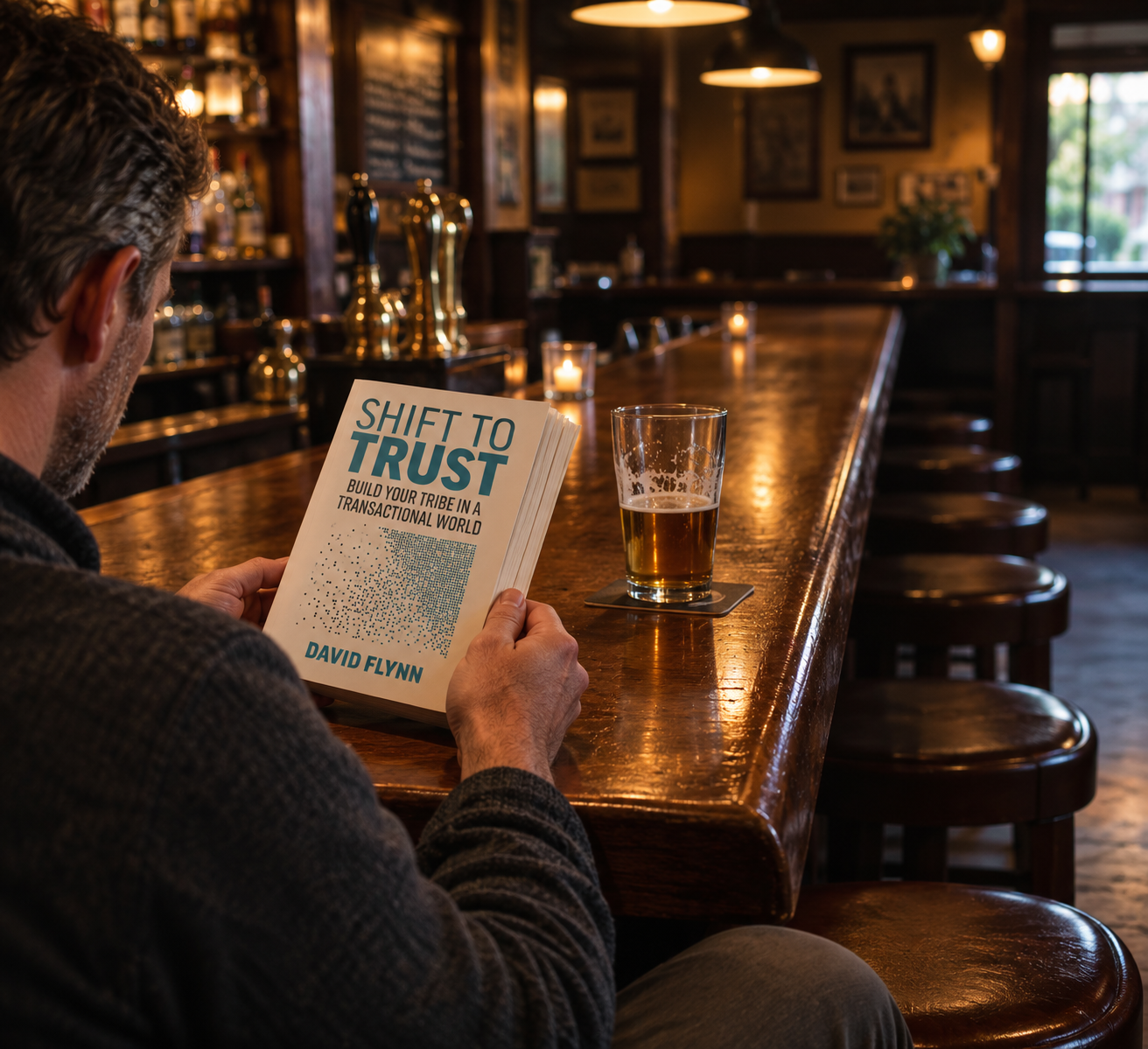
When you see a line at the pub and use that as a signal for quality, it can feel a little like trust. But true trust doesn’t come until those signals are matched with service. Expectations of quality followed by, you know, actual quality.

The longer that matching continues, the more trust will build.
But what happens when you realize the line at the pub isn’t a sign of quality, but of bad management and slow service? You’ll never come back! But don’t get confused. This isn’t a sign that trust is fleeting; it’s a sign that you never had any to begin with.
If your relationships break down quickly—if they leave by Ferrari—that’s how you know it’s trust-lite.
Real trust endures like a cockroach in a candy shop.
You say Furman, I say Furmano
Consider the branding of Furmano’s Tomatoes. These specialty canned tomatoes could be found exclusively at Italian markets across the east coast during the late ‘60s.
Unfortunately for Furmano’s and their customers, most of these neighborhood markets were pushed out of business by large supermarkets. Those who understood fine Italian cuisine and the requirement for good tomatoes would need to find a new brand, because the larger stores didn’t carry the niche Furmano tomatoes.
But cooks were in luck. There was another canned tomato, Furman’s, that was of equal quality. Equal, because it was the same.
Furman Foods, Inc., founded in 1921, had been trusted to provide high-quality tomato products, canned at the peak of freshness, for generations.

But 40 years in, Furman Foods decided to add an “O” to the family name when selling to these Italian markets. They wanted to sound more Italian. The shoppers that frequented these Italian markets were accustomed to buying products that ended in a vowel, just like they grew up with.

And because of that O, Furmano’s was a name they trusted.
Branding these tomatoes as Italian helped them become more likable. Grandma might think back to the old country. “I knew some Furmano’s in my youth. Great people, lovely family.”
And the name provided authority too. Who knows tomato sauce better than a nice Italian family?
But this wasn’t trust. It wasn’t trustworthy. I might even go as far as to say it was lying, but this is business, so we’ll just call it clever marketing.
It wouldn’t be surprising to hear that Furman Foods, Inc. was labeling products as O’Furman for Irish markets or La Furmano to Spanish markets.
Was this trust?
Furmano’s has all but scrubbed this name swapping history from the internet. They eventually went all in on the Furmano’s name.
I’m not sure how their founder, J.W. Furman, would have felt about it. I’m not sure how their long standing Furman customers felt either.
Were they leaving by Ferrari?
The Nature of Trust
The idea that trust comes by carriage and leaves by Ferrari has it backwards.
Trust, for most of us, comes quickly. It starts as trust-lite, trust-ish, or trust-adjacent. It starts with something small, like a vowel at the end of your name. It starts with some level of influence, a proxy for trust, and it builds over time. Eventually, it’s almost impossible to extinguish.
To build trust, you need to be trustworthy—responsible and reliable.
The Furman family was a bit misleading, weren’t they? This wasn’t Nabisco launching a new line of cookies. This was, supposedly, a family name. If customers were just hearing about the brand, still comparison shopping, and knew about their scheme to try and sound more Italian, they may have felt deceived. These days, they would have said their heritage was being appropriated.
But most of these people just needed tomatoes for dinner. And they knew that the Furman family, and the Furmano’s brand fit their needs. They knew that because they’d used them for years, with one label or another. The signals were matched by the service. Responsible and reliable. It was a trusted tomato.
Customers trusted them. And even a strange and slightly shady name change couldn’t change that.
Like a cockroach in a candy shop.
If it was just the name, just that vowel at the end, it would be trust-lite, trust-ish, trust-adjacent.
But don’t confuse that with trust.
If you enjoyed this post, please share it with a friend.