Listen to this post: Apple Podcasts | Spotify | YouTube

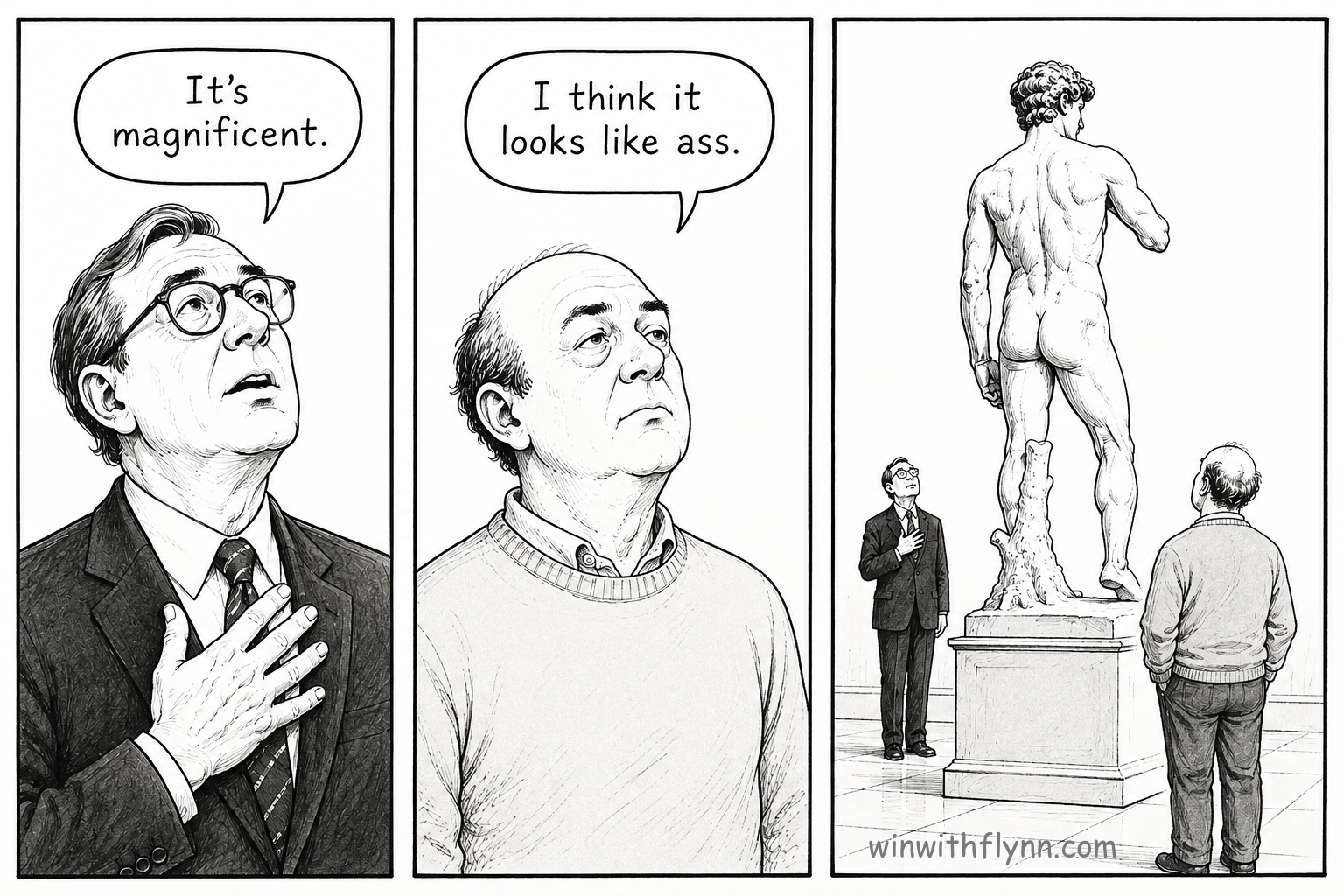
On any given morning, at the Galleria dell’Accademia in Florence, two men approach the statue of David. One of them is moved. “It’s magnificent,” he says. The other, less impressed, “I think it looks like ass.”
Of course, the second man is stationed at the rear of the statue. His take is unarguably correct, in its own way.
Same statue and two honest reactions.
David Lynch liked the saying: “the world is as you are.” He felt that films “are as you are” as well. He wrote, “although the frames of a film are always the same—the same number, in the same sequence, with the same sounds—every screening is different. The difference is sometimes subtle but it’s there. It depends on the audience.” He described a circle from the audience to the film and back again. “Each person is looking and thinking and feeling and coming up with his or her own sense of things,” and he acknowledges that what they feel can be quite different from what he felt while making it.

David Lynch made his peace with the circle. For Bruce Springsteen it would take a bit more time.
In Hammonton, New Jersey, on September 19, 1984, Ronald Reagan was on the reelection trail. “America’s future rests in a thousand dreams inside your hearts,” he said. “It rests in the message of hope in songs of a man so many young Americans admire—New Jersey’s own Bruce Springsteen.”
Born in the U.S.A. had been co-opted by the Reagan campaign without permission. Springsteen’s story was about a Vietnam vet born “in a dead man’s town”—was that the message of hope Reagan’s speechwriters had in mind?
The song was being interpreted as fist-pumping patriotism.
A few nights later, on stage, Springsteen mentioned that the President had name-checked his music—and said he didn’t figure Reagan had been listening to Nebraska. Then he went into “Johnny 99.” Another “message of hope,” this one about a laid-off man facing down a judge.
Over time, Springsteen made his peace with it. In his 2016 memoir Born to Run, he writes: “Records are often auditory Rorschach tests; we hear what we want to hear.”
Two Camps, One Moon
There’s a meme going around about how every man over 40 secretly thinks about the Roman Empire once a day. But what about Mesopotamia? I fell into an Alexander the Great documentary a few months back and haven’t fully climbed out.
Care to jump in with me?
The sprawl of Darius’s encampment stretched across the Mesopotamian plain like a city of silk and steel. Hundreds of thousands of men—Persians, Bactrians, Indians, Scythians—gathered from the edges of the empire, their cookfires dotting the darkness like fallen stars.
As the moon climbed higher, a shadow began to creep across its face.
Warriors paused mid-conversation. The clatter of armor and the murmur of voices died away. Horses shifted uneasily. The moon—pale and full just moments before—was being devoured by darkness, bite by bite.
The magi emerged from the royal pavilion, white robes ghostly in the fading light. They pointed skyward, their voices rising in dread. Soldiers gripped their amulets. Some fell to their knees. The moon, they whispered, was the symbol of Persia itself—and now it drifted into shadow.
In his golden tent, King Darius III stared upward through the open flap, watching the light drain from the sky. Around him, his generals fell silent. No one dared speak but one thought permeated the group: The gods have abandoned us.

Across the plain, the Macedonian camp was smaller, tighter—a coiled fist compared to Persia’s sprawling hand. Veterans of a dozen campaigns sat around their fires, checking weapons with the calm of men who’d seen worse odds.
Then the moon darkened for them as well.
Alexander stood before his tent, surrounded by his companions. He tilted his head back, watching the copper-red shadow claim the moon inch by inch. His men gathered around him—phalanx fighters, cavalry, archers—all eyes turned upward.
Aristander the seer stepped forward, his voice carrying across the hushed crowd: “The moon falls under shadow—but it does not die. As the light returns, so shall our victory come. The gods have spoken. Before this moon is full again, Persia will kneel.”
A roar erupted from the Macedonians. Spears hammered against shields in rhythm, rolling across the plain. Alexander smiled. A grin his men knew well. He raised his fist to the moon above.
Under the same darkened sky, the same blood-red light, one army saw their doom written in the heavens. The other saw its destiny.
See? Us old guys and our historical fascinations aren’t a total waste. Sometimes we make blog posts.
But what a story.
Same sky. Two readings. Each camp saw what it already believed.

The Field Trip and the Partial Truth
The students were buzzing with excitement. Today wasn’t just any field trip—they were getting a private tour of the zoo, where they had a brand-new elephant exhibit.
It was pitch black inside the room where the elephant stood.
“It’s Winston,” said Ms. Lin, their teacher. “The first African bush elephant born in North America in forty years. You can pet him—carefully.”
The students lined up: Maya, Ben, Chloe, Liam, Samira, and Noah. They couldn’t see much, but they could make out the elephant’s shape in the darkness.
“Remember,” Ms. Lin said. “One at a time, gently. Take your time. Think about what you feel.”
Maya went first. Her hands landed on the elephant’s side. Broad, warm, and slightly rough. She pulled back. “It’s like a wall!” she declared. “Solid, strong.”
Ben reached out and felt the tusk. “No way,” he said. “This elephant is sharp, like a spear.”
Chloe grabbed the trunk. “You’re both off,” she said. “It’s long and bendy—like a snake!”
Liam felt a leg. Sturdy and straight. “You have to feel the base,” he said calmly. “It’s like a tree.”
Samira found an ear. Big and flappy. “Seriously?” she said. “Anyone can tell this is like a fan!”
Noah, at the very back, felt the tail. Wiry and stiff, ending in a bristly brush. “Nope. It’s not a wall, or a spear, or a snake, or a tree, or a fan,” he said. “It’s more like a rope!”
Ms. Lin smiled as she guided them out of the dark room.
On the bus ride back, the debate erupted again. Each student argued their part, sure that they had it right. And they were. Each was right about the piece they’d touched—but none had felt the whole animal.
When you’re that close—when you only touch one part of something—you don’t see the whole picture.
You discover a tidy, confident analogy. And then, if you’re not careful, you start defending that analogy instead of investigating the elephant.

Bruce Springsteen said we hear what we want to hear. Maybe we do the same with what we see and feel. We reach for the part that confirms the story we already believe.
Under that blood-red moon, the Persians and Macedonians weren’t only interpreting the eclipse differently. Their interpretation was becoming part of the event.
Once you believe the story, you’ll act as though it’s true. And sometimes, that’s enough to make it so.
Your experience of the elephant is just as real as David’s ass. But sometimes we mistake these experiences for truth.
Which brings us back to the museum.
The statue of David. The paintings. The banana duct-taped to the wall.
You have your reaction. You love it, or hate it, or think the artist is a genius. Fine. That’s your slice. But do yourself a favor. Take a walk.
Somewhere behind you, the curator is watching attendance. A manager is watching throughput. The janitor is mopping, irritated by the footprints. The café has a line twenty deep. A kid is bored to tears. Someone is having the best damn day in months.
If you’re a little bit brave, you’ll meander around the exhibit and see it from the other side. If you’re a little bit curious, you start seeing the museum, all the other stories being played out around you.
Stay planted and you’ll end up critiquing the people instead of the piece.
The exhibit is the circle. The museum is the sphere.
If you enjoyed this post, please share it with a friend.








What do you think?